Common Amana dryer problems
Reliable Amana dryer repair covers both fuel types — the electric NED dryers (NED4655EW, NED5800HW) and the gas NGD dryers (NGD4655EW, NGD5800HW) — built around Automatic Dryness Control, the AutoDry System, and the Wrinkle Prevent Option. Amana dryers are mixed when it comes to diagnostics: electronic-display models show genuine codes, while the bulk of the budget timer-controlled models signal by symptom only, with no code at all. The problems we see most are a dryer that is not heating, a restricted-airflow AF (also F4E3) code or symptom, a PF power failure or an L2 low-voltage condition, a sensor failure (F3E1/F3E2), a unit that will not start or has a dark display, a drum that will not turn, a load that takes too long or overheats, and noise or a burning smell. Tumble Press®, the SofSound™ Quiet Package, and the AutoDry System keep these dryers gentle on clothes, but elements, igniters, thermostats, belts, rollers, and sensors still wear with use.
Our Amana dryer repair process
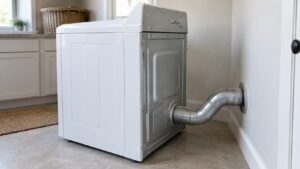
As an independent, third-party service our experienced technicians begin every Amana dryer repair by confirming the fuel type and whether the model is electronic or timer-controlled, then read any code before testing the named part. A no-heat problem sends them to the heating element, thermal fuse, and high-limit thermostat on an electric NED, or to the igniter, gas valve coils, and flame sensor on a gas NGD — where the igniter is the most common cause. An AF or F4E3 sends them straight to the exhaust duct and lint path, because restricted airflow is by far the most common cause and is usually a venting problem rather than a part. An L2 sends them to the 240V supply and the outlet on an electric dryer, and an F3E1/F3E2 to the exhaust thermistor and moisture sensor that the Automatic Dryness Control depends on. We fit genuine OEM parts from trusted parts suppliers and back the work with a 30-day labor warranty. You can book a dryer repair online, with a clear quote before work begins and a total that depends on the diagnosis.
Amana dryer models we service
We service the current US Amana dryer lineup in both fuel types. Electric NED models include the NED4655EW and NED5800HW, and gas NGD models include the NGD4655EW and NGD5800HW, with older builds such as the NGD5240TQ serviced as repair-lookup work. Note that trailing-digit forms like NED4655EW with a suffix are parts revisions, not separate retail models, so the base model is confirmed before ordering. These dryers carry Automatic Dryness Control, the AutoDry System that judges the load by sensor, the Wrinkle Prevent Option, Tumble Press®, and the SofSound™ Quiet Package. A key service distinction is that electronic-display models show genuine codes while the many budget timer-controlled models are diagnosed by symptom only — so the technician confirms which kind you own before deciding whether to read a code or work the problem by observation. Our model directory lists the heating elements, igniters, gas valve coils, thermostats, thermal fuses, belts, rollers, sensors, and control boards matched to each build so the correct genuine OEM part is sourced the first time.
Error codes and diagnostics
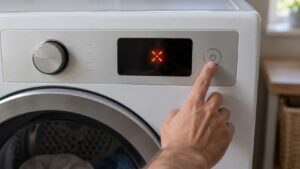
Amana dryers are diagnosed two ways. Electronic-display models report letter codes — PF (power failure), AF (restricted airflow), and L2 (low or no line voltage) — plus the F#E# scheme: F2E1 (stuck key), F2E2 (UI disconnected), F3E1 (exhaust thermistor), F3E2 (moisture sensor), and F4E3 (restricted airflow, = AF). Older numeric boards instead show F## codes such as F22/F23 (exhaust thermistor open or short), F24/F25 (inlet thermistor), F28/F29 (moisture sensor), F30 (restricted airflow), and F31 (low voltage). The many mechanical-timer models — the bulk of budget Amana dryers — have no code at all and are read by symptom: no heat, will not start, will not tumble, takes too long, overheats, noise, or a burning smell. Note that dET and Et are washer codes, not dryer codes, and Samsung tS/bE or LG d80 codes do not apply here. Our technicians confirm each code or symptom at the named part, and you can look it up on our dryer error-code guides.
Service areas
Our specialist technicians cover all 50 states and the District of Columbia plus 40-plus metro areas, with a standard 24-48 hour response and same-day visits where availability allows. Every visit is handled by a skilled technician who carries the diagnostic tools and the genuine OEM parts most likely needed, so the problem is identified and, wherever possible, fixed on the first trip. Because so many Amana dryer no-heat and takes-too-long complaints trace to a restricted vent rather than a failed part — and because a budget timer model carries no code to read — an experienced technician saves you the cost of a needless repair by clearing the airflow path and reading the symptom correctly first. Full specifications and the current dryer lineup are published by the manufacturer at amana.com. Find your area on our service locations page, browse step-by-step help in our repair guides, or book any service through the scheduling page.