An Amana coil range element is a coiled length of resistance wire that glows red-hot when current flows through it, and the knob you turn does not make it hotter or cooler. It decides how much of the time the element is on. A switch behind the knob, called an infinite switch, pulses the element on and off, and the ratio sets the heat. That one idea explains most of what you see on a coil cooktop, from the clicking and the uneven glow to the element that works only on high.
What is a coil surface element on an Amana range?
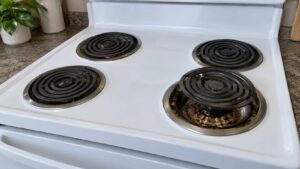
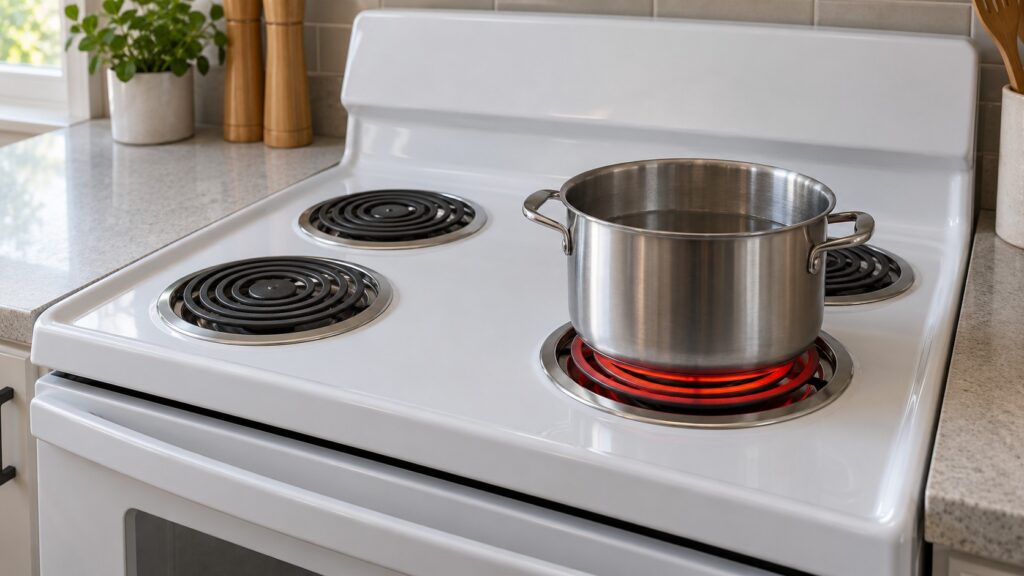
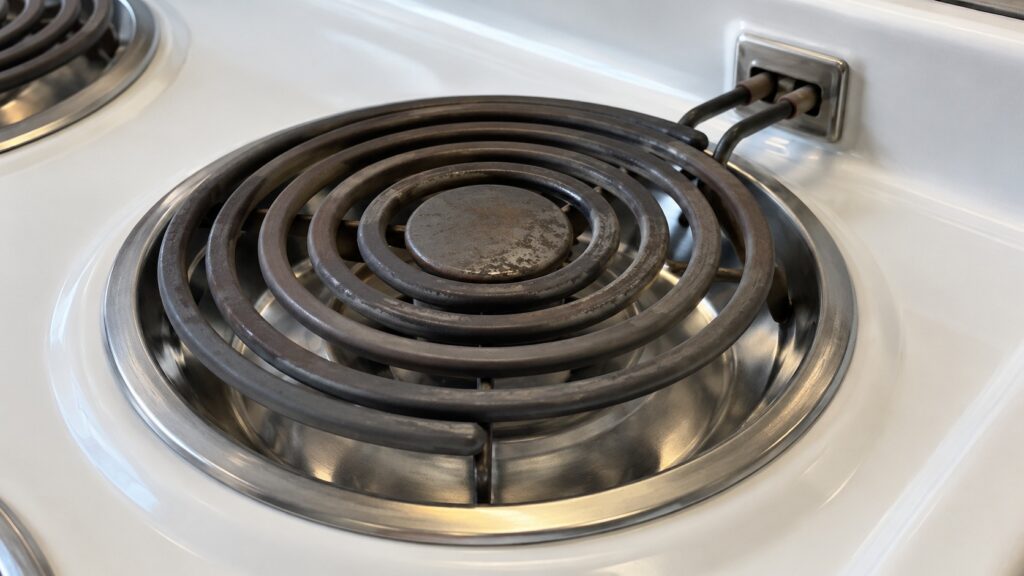
Our model pages list the cooktop of the ACR4303MFW and the other ACR ranges as coil surface elements, which means exposed coils sitting on the cooktop rather than a flat glass surface. Each element is a resistance coil: electricity meets resistance in the metal, the metal heats up, and the heat goes straight into the pan sitting on it. There is no flame and no moving part. The simplicity is the appeal of a coil range, and it is why the faults are usually easy to describe even though the repair is not always an owner job.
Next to the coil you will see a ring-shaped metal drip pan beneath it. The pan is not part of the heating circuit. It catches spills so that they do not run into the cooktop. Our Amana range cooking tips cover matching the pan to the element, which matters more on a coil than on a smoothtop.
How does the knob control the heat of a coil element?
A coil element has no way of running at half power. It is either fully on or fully off. Behind the knob sits the infinite switch, which opens and closes the circuit over and over. On a low setting the element is on for a short part of each cycle and off for the rest; on high the switch stays closed nearly all the time. That is why a coil on a medium setting glows, fades and glows again, and why you may hear a faint click as the switch cycles. All of that is normal. Our guide to Amana range surface element problems explains that this switch carries the full current of the element every cycle for years, which makes it the most heavily worked part in the circuit.
What the dial setting means in terms of actual temperature differs by model and by pan, so we do not quote figures. Use the settings the way your owner’s manual describes, and judge the heat by what the food is doing.
How does the element connect to the range?
On the plug-in coil style, the two ends of the coil are terminals that push into a receptacle in the cooktop, and the element rests on the receptacle and the drip pan. The terminal and receptacle carry heavy current, so they are the part most affected by boil-overs and by age. A spill that reaches the terminals can corrode the contact, and a corroded contact runs hot. Our surface-element guide describes a browned or pitted receptacle as a fire risk and a common failure, and says the receptacle is replaceable.
Whatever sits under the cooktop, the receptacle wiring, the switch and the supply, runs on 240 volts. Looking is fine. Opening the cooktop or the rear panel to get at it is a technician’s job.
What makes a coil element glow unevenly or fail?
The coil is metal that is heated to glowing and cooled again several times a day, and metal tires under that cycling. Our guide puts an ordinary lifespan at ten to fifteen years, and says the spread comes mostly from how the element is used. Three habits shorten it. Boil-overs that reach the terminals corrode the connection. Dragging heavy pans across a coil bends it, and a bent coil has hot spots that fail first. And running an element on high with nothing on it, or with a pan much smaller than the coil, sends heat nowhere except into the element itself.
The symptoms map neatly onto the parts. An element that glows in patches is a coil that has degraded. An element that works only at full power whatever the knob says points to the infinite switch, which usually fails closed. A single element that is dead while the others work is that element’s own circuit: the coil, the switch or the connection between them. All four dead while the oven and clock still work is a supply problem and not an element problem.
What can you safely check yourself?
- Which elements are affected. One element, several or all of them? The pattern tells a technician a great deal.
- The control lock. An engaged lock makes a cooktop look dead while the oven works normally.
- Cookware. A warped pan touches the coil only at its rim and heats slowly; a pan far smaller than the coil wastes the heat.
- The receptacle, by eye. Browning or pitting at the terminals means stop using that element and call.
- Cleanliness. Lift spills off the drip pan once the cooktop is cold; do not let them bake onto the terminals.
Our guide mentions a swap test on plug-in coil elements, where you exchange a dead element with a working one and see whether the fault follows the element. If your owner’s manual describes removing and replacing the element, follow it exactly, with the cooktop completely cold and the range switched off, and stop if anything is burnt or loose. Do not go further than that. For routine care see Amana range maintenance.
When should you call a technician?
Call when an element is dead and the receptacle looks healthy, when an element is stuck on or works only on high, when a receptacle is burnt, or when anything involves wiring behind the cooktop. If you see arcing, smell burning at the cooktop or find a glowing patch that should not be there, switch off the breaker at the panel while standing on a dry floor and leave the range off. On an older range with several faults, Amana range repair or replace helps with the decision, and the range repair page explains how a visit works.