An Amana range surface element that will not heat, heats on one setting only, or glows unevenly is one of the more approachable faults in the kitchen — because a radiant cooktop is a simple circuit and the failure is usually in one of three places. Knowing which three saves you from the two things people do instead: living with a dead burner for a year, or replacing a working range.
Start by mapping which elements fail
The pattern of what works tells you more than any single symptom. One element dead while its neighbors work is that element’s own circuit — a component fault. All four dead while the oven and the clock still work is a supply problem, because a range runs on two legs of 240 volts and losing one takes out half the appliance while leaving the 120-volt electronics alive.
That second case sends people to the appliance when the problem is the breaker, the connection at the range, or the outlet. It is worth checking the breaker properly — a double-pole breaker can trip on one side and look closed — before anything else.
The infinite switch is the part that fails most
A radiant element does not vary its power. It is fully on or fully off, and the knob controls a switch that cycles it — on for a few seconds, off for a few, with the ratio setting the heat. That switch carries the full current of the element every cycle, for years, and it is the most heavily worked part in the circuit.
When it fails it usually fails closed, which is why the classic symptom is an element that works only at full power regardless of the knob. Less often it fails open and the element does nothing at all. Either way it is a discrete, replaceable part, and replacing it does not touch anything else in the range.
What you can safely check
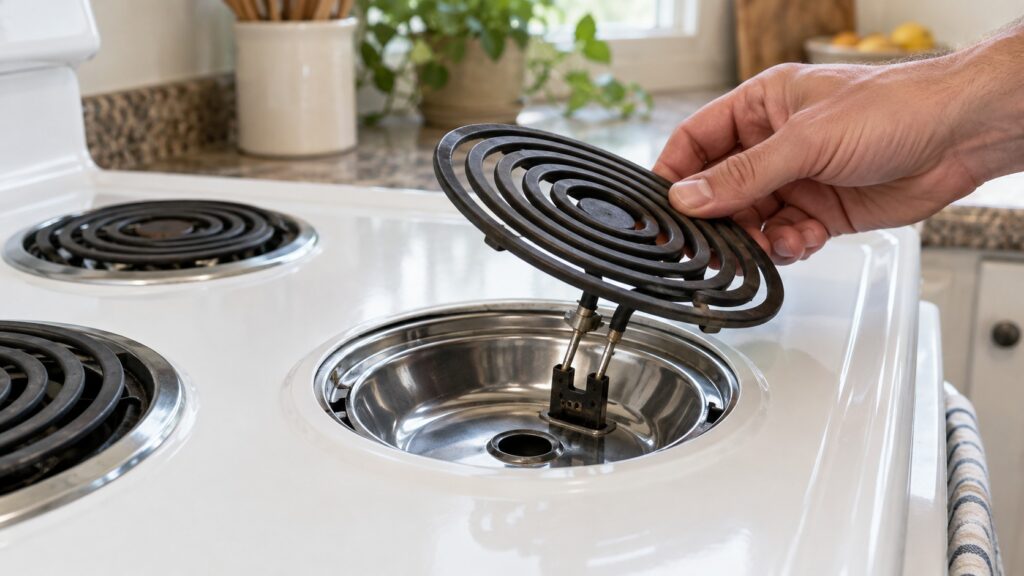
- Swap test on a coil range. If the elements plug in, swap a dead one with a working one. If the fault moves, it is the element; if it stays, it is the receptacle or the switch. Do this cold, with the range unplugged.
- Look at the receptacle on a plug-in element for browning or pitting. A burnt receptacle is a fire risk and a common failure, and it is replaceable.
- Check the breaker for a half trip, as above.
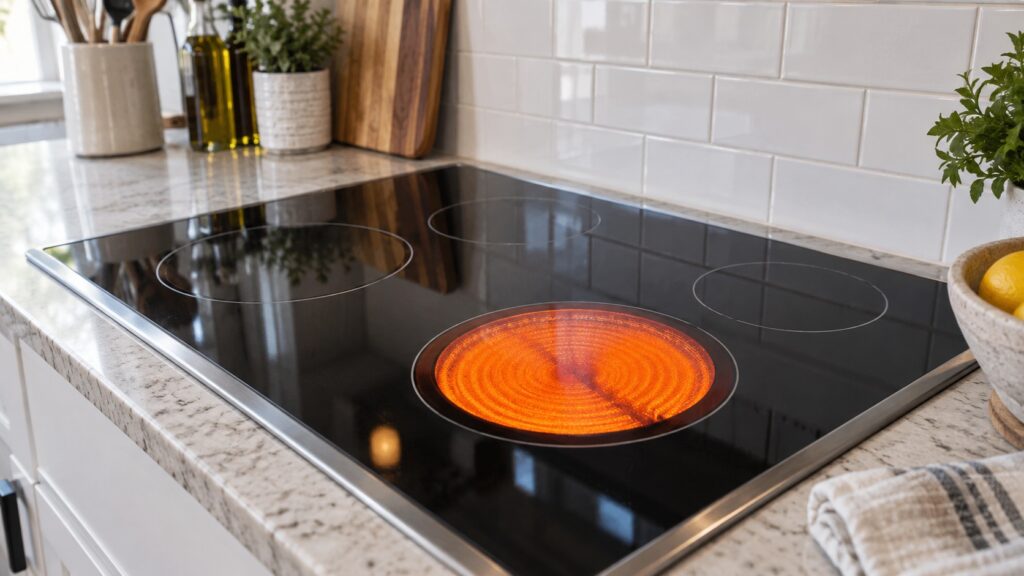
- Watch a glass top element come up. Even glow is healthy; patchy glow is a failing coil.
Stop before opening the cooktop or the rear panel. Those enclose 240-volt connections, and on a glass top the elements are bonded to the underside of a panel that cracks easily in handling.
Glass tops fail differently from coils
On a radiant glass cooktop the element sits under the glass and is not user-replaceable in any meaningful sense — the job involves lifting the top. The compensation is that glass-top elements fail less often than coil elements, because they are not plugged and unplugged and not exposed to spills directly.
What does affect them is the glass. A cracked top is not repairable and it is not safe to use: moisture reaching the element beneath is a shock risk. That is a replacement, and on an older range it is one of the few cases where the range itself becomes the question — see our repair or replace guide.
How long elements last, and what shortens it
A surface element is a resistance coil that is heated to glowing and cooled again several times a day, and metal fatigues under that cycling. Ten to fifteen years is ordinary; the variation comes almost entirely from how it is used rather than from the make.
Three habits shorten it noticeably. Boil-overs that reach the element terminals corrode the connection, and a corroded connection runs hot and eventually fails — which is also what burns a receptacle. Dragging heavy pans across a coil distorts it, and a distorted coil has hot spots that fail first. And running an element on high with nothing on it, or with a pan much smaller than the coil, sends the heat nowhere and cooks the element itself.
Things that look like element faults and are not
Cookware accounts for a share of these calls. A warped pan touches the element at its rim and heats slowly; a pan much smaller than the element wastes most of its output around the edges. A glass top with a burnt-on deposit under the pan insulates it from the element.
The control lock is another. An engaged lock makes a cooktop look dead while the oven works normally, and it is engaged by accident more often than people admit. Our guide on Amana range cooking tips covers both, and the range error code archive covers what a display is reporting.
Gas ranges are a different problem entirely
None of this applies to a gas burner, where the failures are ignition, gas flow and burner cleanliness rather than elements and switches. If your range is gas, our page on a gas burner that will not light is the right starting point.
When to call
A dead element with a healthy receptacle, a switch that has failed, a burnt receptacle, or anything involving the wiring behind the cooktop is a service job — not because it is complicated, but because it sits on 240 volts and a bad connection there is what starts fires.
We are an independent repair company, not a factory service arm. Pricing starts from a diagnostic visit and we confirm the estimate before any work begins. Amana range repair covers elements, switches and wiring, and you can schedule a visit online. For upkeep rather than faults, see our range maintenance guide.