An Amana oven thermostat is not one part but a loop: a temperature sensor in the oven cavity tells the electronic control how hot it is, and the control switches the bake element on and off to hold the temperature you set. On Amana electric ovens and ranges that sensor is an RTD, a probe whose electrical resistance changes with heat, and the control is the Easy Touch Electronic Control. When the loop works you never notice it. When the sensor is wrong, the oven bakes too hot, too cool, or refuses to heat at all.
What does the oven thermostat do in an Amana oven?
It answers one question over and over: is the oven at the temperature you asked for? An older oven did this with a simple mechanical thermostat. Amana ovens with Easy Touch Electronic Controls do it electronically, and our Amana oven tips describe the arrangement: separate bake and broil elements, switched on and off by the electronic control to hold the temperature its sensor reads. Which of those two designs your own oven uses depends on the model, and the owner’s manual is the place to confirm it. If your range has a dial and no electronic display, the thermostat may be a mechanical part instead, and the fault codes in this guide will not apply.
How does an Amana oven hold its temperature?
The control compares the sensor reading with the set point. Below it, the bake element is on; at it, the element switches off; as the oven cools slightly, it switches on again. That is why you hear and see the element cycling, why the preheat tone sounds before the cavity is truly stable and why the temperature wanders a little around the setting. Bake uses both elements gently for even heat and broil fires the top element hard, as our oven tips guide says. Preheating, rack position and a crowded rack change results as much as the sensor does, so see Amana range cooking tips before you decide the oven is off.
What happens when the oven sensor goes wrong?
Our guide to an Amana range oven not heating explains that the control will not heat if it cannot trust the sensor. An F3 E0 code means the control sees an open sensor circuit and F3 E1 a shorted one, and in either case it stops heating to stay safe. Our F3E0 sensor guide goes into that code. A sensor that has drifted without tripping a code is subtler: the oven heats, but the real cavity temperature is no longer what the control believes, so food bakes too fast or too slow. Our oven tips guide calls this a drifting sensor and lists it among the usual causes of uneven results.
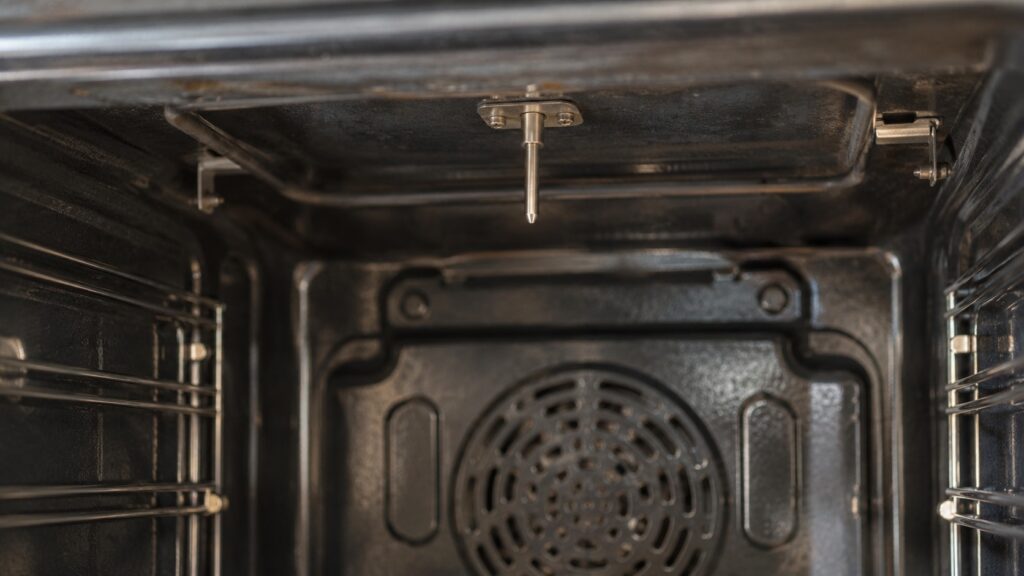
How can you tell whether the oven temperature is off?
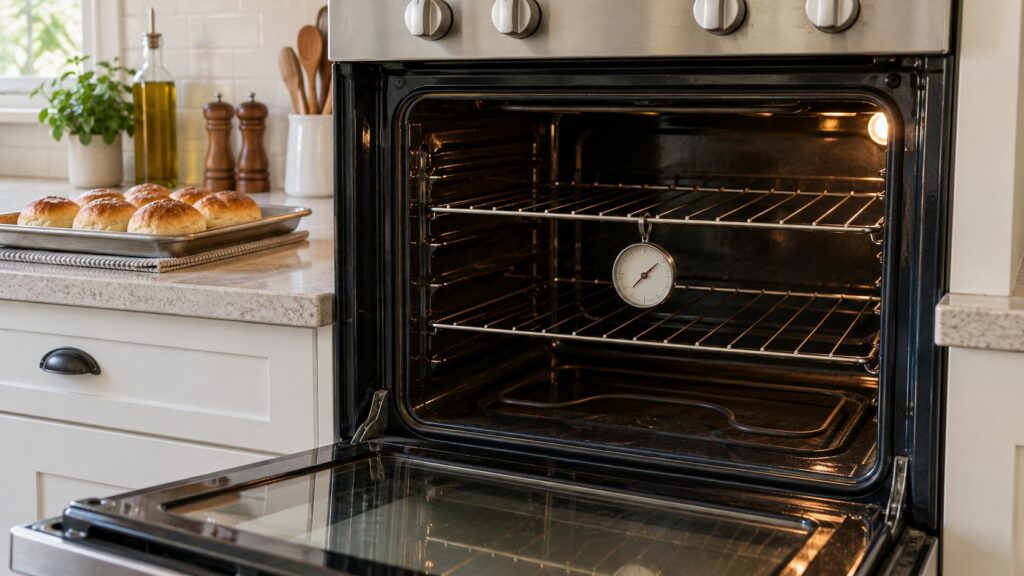
An inexpensive oven thermometer, set on the middle rack, is the simple test. Preheat fully, give the oven a few extra minutes after it signals ready, and compare the thermometer with the setting. One odd reading means little; the same difference every time points to a sensor or control that needs a technician. Whether your oven allows you to adjust its temperature to compensate is something only your manual can say, and we will not describe a button sequence our pages do not list. Do not move or bend the sensor probe while you check; it is a delicate part, and your manual shows where it sits.
Before you blame the sensor, rule out the ordinary causes of uneven baking. A rack set too high or too low, two pans on one rack that block airflow, a door opened often to peek and an oven loaded before it has fully preheated all produce results that look like a thermostat problem. Run the same simple recipe on the middle rack with the oven fully preheated and see whether the result changes. If it does not, and the thermometer agrees that something is off, you have useful information to give the technician.
What can you safely do yourself?
- Check the settings. Make sure the oven is not in a delayed-start or Sabbath Mode setting and that the door closes fully.
- Reset the range at the breaker. Our guide suggests switching it off for 30 to 60 seconds, then back on, and watching for a returning code.
- Keep the sensor clear. Do not let pans, foil or a baking sheet press against it, and do not clean it with abrasive pads.
- Protect the door gasket. A torn seal lets heat escape and makes the oven run longer.
- Note the code and the symptom. A technician will want both.
Do not open the back or any panel to reach the sensor wiring or the control. Those parts carry 240 volts, and testing them is a technician’s job.
When should you call a technician?
Call if an F3 code returns after a reset, if the oven will not heat, if it is consistently off by the same amount, or if the control does not respond. If you smell burning or see sparks, switch off the range’s breaker at the panel while standing on a dry floor. Our Amana oven repair page explains how a visit works, and for an older oven with several faults, Amana wall oven repair or replace helps with the decision.