An oven that seems stuck is often a feature, not a fault, and Amana Sabbath Mode is the clearest example. The control panel on an Amana wall oven or range carries a handful of modes and names that look like problems to someone who has never used them: Sabbath Mode, Oven Lockout, the Self-Clean Option, an F#E# code and a sensor with a technical name. This glossary explains what each term means, which ones are normal behavior and which ones mean a part has failed, so you do not call for repair when a button press would fix it.
What is Sabbath Mode on an Amana oven?
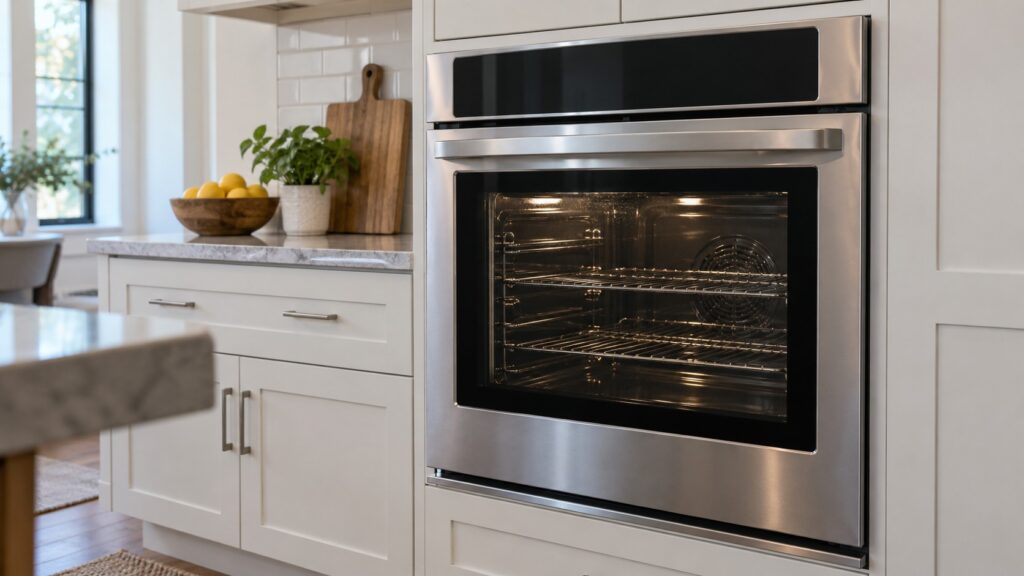
Sabbath Mode is a setting meant for religious observance, and it changes how the oven behaves. Our Amana wall oven model pages list Sabbath Mode among the features, and in general a mode like this limits the controls and quiets the usual signals. Because of that, an oven in Sabbath Mode can look unresponsive: the keypad ignores most presses, the display looks different and the settings may not change until you exit the mode. This is by design.
The exact steps to turn it on and off, and how long the oven stays on, depend on the model, so use your owner’s manual for the key sequence. If your oven suddenly seems stuck and nobody remembers setting it, Sabbath Mode or a lock is the first thing a technician checks, and the check costs nothing.
A related point: after a power cut, an oven that was in Sabbath Mode may come back in a different state from the one you left, so check the display and the temperature before you load food. Never leave the house with an oven in an unknown mode, and do not assume a dark display means the oven is off.
What does Oven Lockout mean on an Amana range?
Oven Lockout, also called a control lock, disables the keypad so a child or a stray touch cannot start the oven. Press and hold the lock pad as your manual describes, and the control wakes up again. The term is also used for the door lock during a cleaning cycle, where the door is held shut for safety until the cavity has cooled. A locked door after self-clean is not a fault. If the door stays locked long after the oven is cool, read our Amana wall oven door locked guide.
What is the Self-Clean Option, and why does the door lock?
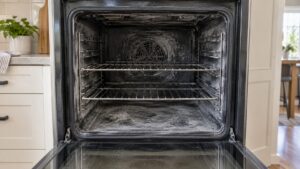
The Self-Clean Option heats the oven to a very high temperature to turn spills into ash that you wipe out afterward. Because the cavity gets so hot, the control locks the door as a safety measure, and it unlocks on its own when the oven cools. Remove the racks and large spills first, and ventilate the room. The cycle puts stress on the latch motor and the control, which is why door lock codes such as F5 E0 and F5 E1 usually appear after a cleaning cycle. Our Amana oven self-clean guide covers the routine in full.
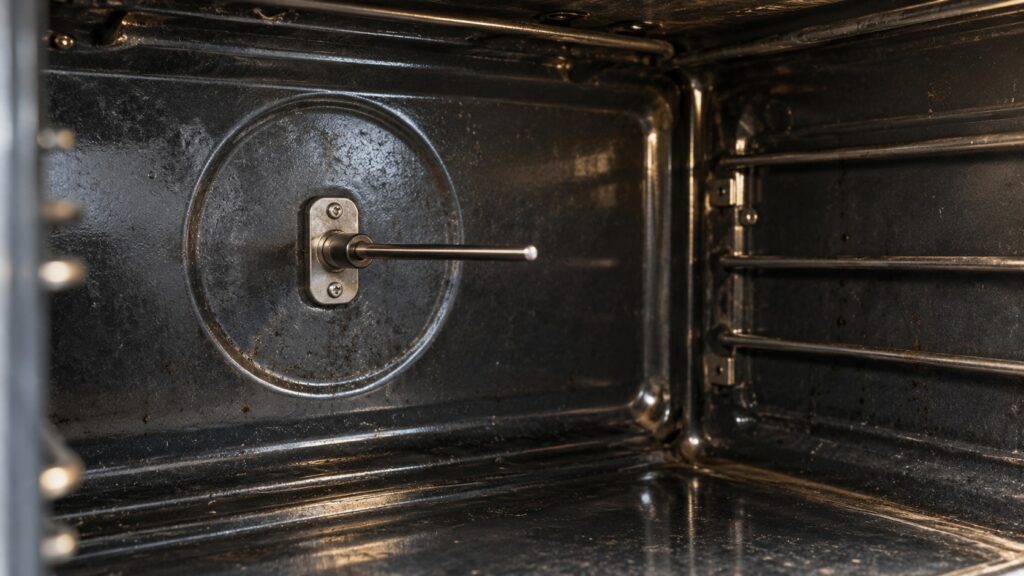
What is the RTD sensor, and what do F3 E0 and F3 E1 mean?
The RTD sensor is a small probe that sticks into the oven from the back wall. Its electrical resistance changes with temperature, and the control reads it many times a minute to decide when to heat. On Amana ovens, F3 E0 means the sensor reads open and F3 E1 means it reads shorted, and either one makes the oven bake hot or cold or refuse to heat. The Amana oven F3 E0 page describes the code, and our oven F3 sensor guide explains the checks.
How do you read an F#E# code?
An Amana Easy Touch oven shows its fault as an F followed by a number, then an E and a second number. The first part names the area, such as the control board, the keypad, the sensor or the door lock, and the second part narrows it down. The oven reports a code when its self-check finds a problem, and it may stop heating while it does. For example, F6 E1 is an over-temperature during a cook, and F9 E0 is an electrical or miswire problem that most often appears on a newly installed oven. The Amana oven F6 E1 page explains the first, and our F9 E0 after install guide the second. For a general overview, see Amana error codes explained, and for the touch panel itself, the Easy Touch controls glossary.
What else is worth knowing about an Amana oven?
The Easy-Clean Glass Door is the inner glass that is made to wipe clean without tools. The extra-large oven window lets you check food without opening the door, which matters because every opening drops the temperature and slows the bake. Warm Hold is a convenience that keeps food at serving temperature. None of these are faults, and none needs service unless a part fails.
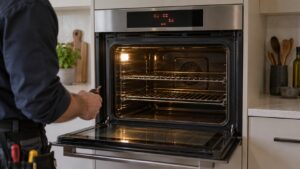
We are an independent repair company, not the manufacturer. If a code keeps returning, or the oven will not heat even after you have checked for Sabbath Mode and a lock, our Amana oven repair service can test the sensor, the latch and the control, and you can book a visit online.