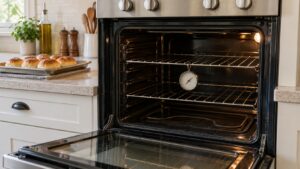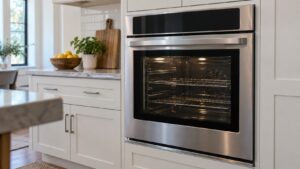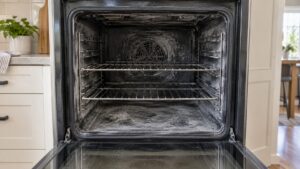
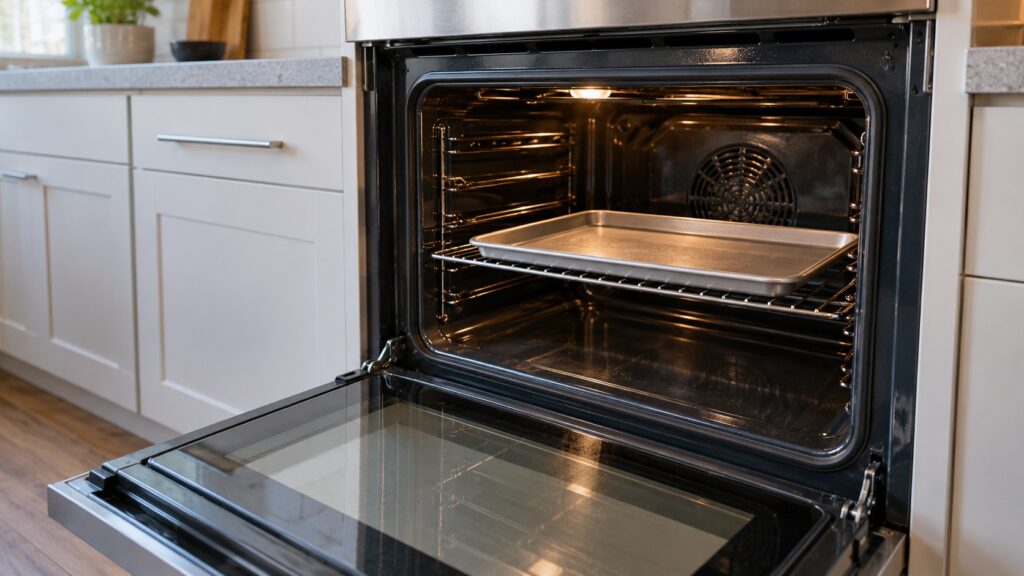
The short answer on Amana oven foil is to keep it off the oven floor and off the heating elements, and to catch drips with a pan on the rack instead. Our Amana oven tips guide says to keep foil off the oven floor and never to line the floor with foil during a self-clean cycle. The rest of this guide covers the other half of the question: where to put the racks, how to use foil on a pan without upsetting the oven’s airflow, which mistakes cause uneven baking and when a bad result means a technician. We give no temperatures or times, because they depend on your recipe and your model, and any rule about foil on your specific oven belongs to your owner’s manual.
Can you put foil on the bottom of an Amana oven?
Our oven tips guide says to keep foil off the oven floor, and that is the advice we repeat. The oven floor and the area around the elements and vents need open airflow, and foil can block that airflow, trap heat and, if it touches an element, cause damage. It also does not stay put: a sheet of foil on the floor can slide, curl or melt onto the surface during a cleaning cycle. We cannot say what your specific model allows, so check your owner’s manual, which tells you whether any liner is permitted and how.
The same goes for covering a whole rack with foil. A big sheet that hangs over the edges can stop hot air from circulating and make the oven bake unevenly. Use foil on a pan or tray, with the edges folded in, not draped across the rack.
How do you catch drips without foil on the floor?
Put a baking sheet or a shallow pan on the rack below the dish that might drip, such as a pie or a casserole. If you want easy cleanup and your manual allows foil on a pan, line that pan with foil, keeping the foil flat and inside the pan, with nothing touching the oven walls or elements. Leave space around the pan so air can move. When the pan cools, lift out the foil with the spill, and wipe the pan. This keeps the oven floor clean without blocking airflow. Our self-clean maintenance guide explains why any spill on the floor matters before a cleaning cycle.
For large spills that do reach the floor, wait until the oven is cool and wipe them up. Do not scrape with sharp tools. Before a self-clean, remove large spills, ventilate the kitchen and take the racks out unless your manual says they are rated for the cycle, as our oven tips guide advises.
Where should the racks go?
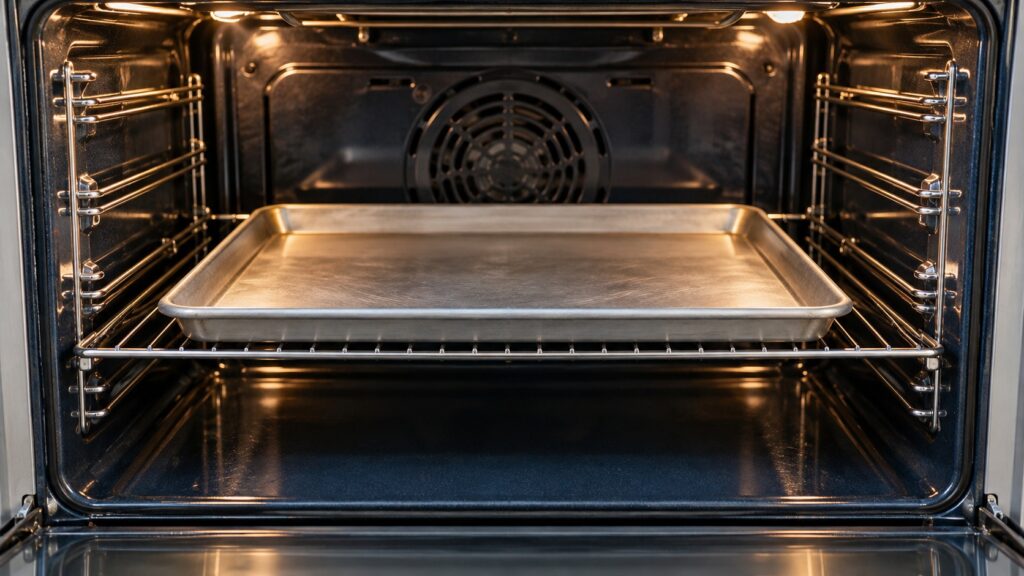
Rack position changes how food browns, because the elements are at the top and bottom. A rack near the top gets more heat from above, which suits browning, and a rack lower down gets more heat from below. Most baking works best with the food in the middle of the oven, where heat is most even, but follow your recipe and your manual. Our oven tips guide notes that most uneven-cooking complaints trace back to preheating, rack position or a drifting sensor, not a failed oven, so check those before you suspect a part.
Leave space between a pan and the oven walls so air can circulate. Do not put two large pans so that one blocks the other, and use one rack at a time unless your oven is designed for several. Arrange the racks before you turn the oven on, never while it is hot, and use oven mitts when you must move one.
Take a moment to look at the racks themselves. They should slide in and out smoothly, sit level on their supports and stop before they fall out of the oven when you pull them forward. A rack that is bent, wobbly or put in upside down can tip a hot dish. If a rack looks damaged, replace it before it causes a spill. Racks can also discolor in a self-clean cycle, so our oven tips guide suggests removing them before the cycle starts. Wipe them by hand when they are cool, using a non-abrasive pad and mild soap, and dry them before they go back in.
What other habits help baking?
Preheat as your oven’s signal directs, keep the door closed as much as possible, because each opening lets heat out, and use light-colored, flat pans for even results. Dark pans can brown the bottoms faster. Keep the door gasket clean and undamaged; our oven tips guide says a torn or crushed seal makes the oven run longer and bake unevenly. If your oven has convection, follow the manual for how it changes cooking. Our oven tips guide and range cooking tips add more.
When does uneven baking mean a technician?
If the oven bakes unevenly even with racks and pans arranged sensibly, if it does not reach temperature or if it shows a code, the sensor or an element may need testing. Our oven F3E0 sensor guide and oven not heating guide cover the related faults. If foil has touched an element and you see damage, smoke, sparks or a burning smell, turn the oven off, switch off the breaker at the panel while standing on a dry floor and do not use the oven. If you smell gas on a gas model, do not switch anything on or off, leave the house and call the gas company or 911 from outside. We are an independent repair company. See our Amana oven repair or schedule a visit.