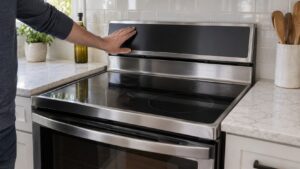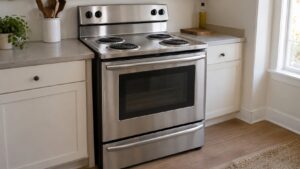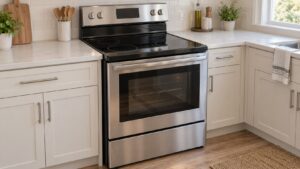
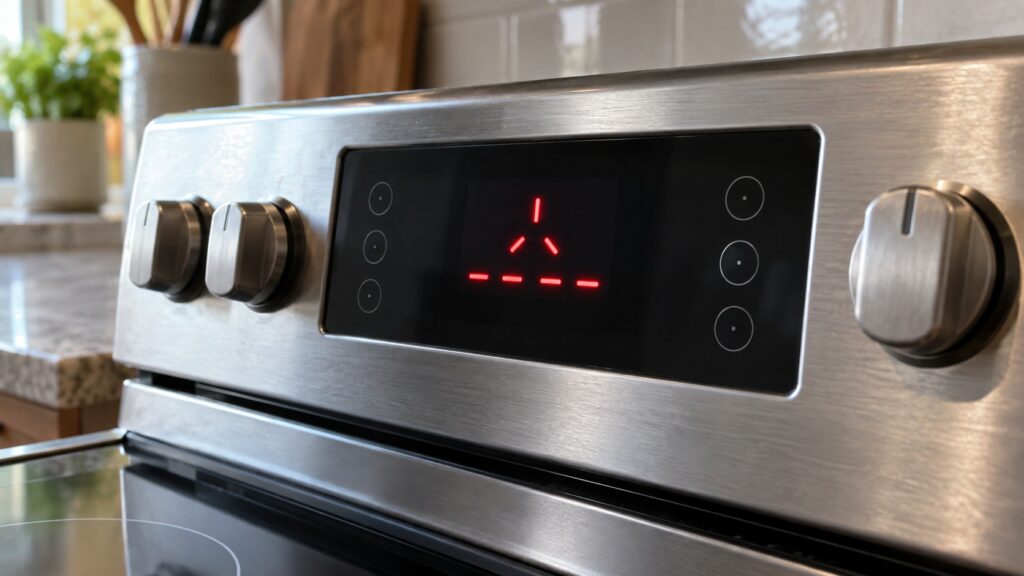
Amana error codes come in four different grammars, and the single most useful thing to know is that they are not interchangeable. A one-character code such as F1 or F9 on an older control means something completely different from the pair F1 E0 or F9 E0 on a newer one. A two-letter code on a washer is usually a prompt rather than a fault. A two-digit dryer code points at one sensor. Read the shape of the code first, then the meaning.
What do Amana error codes actually tell you?
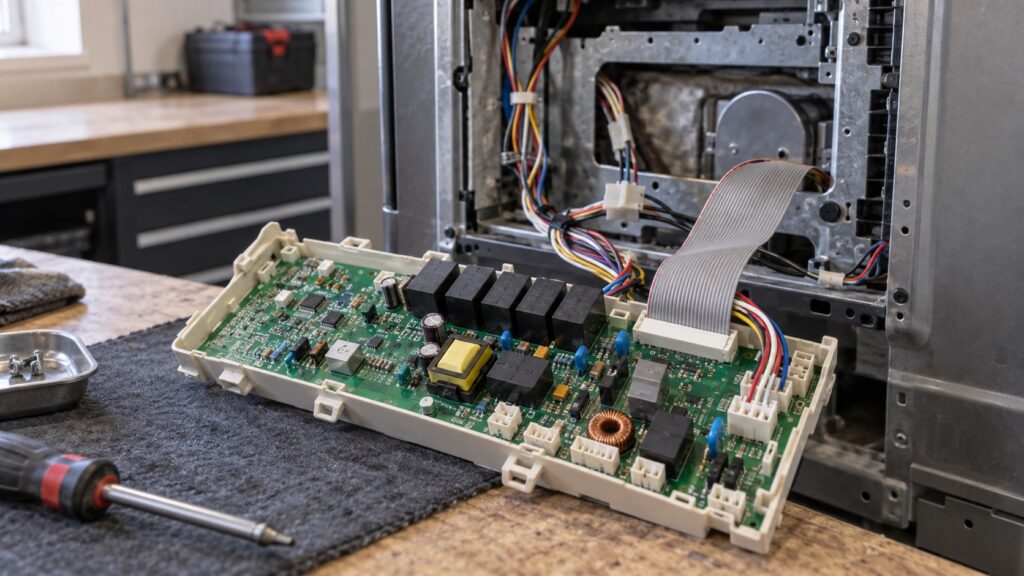
An Amana control does not detect faults the way a person does. It watches a handful of measurable things: the resistance of a temperature sensor, whether a latch switch closed, whether a fill produced a weight change, whether the two boards inside the machine are still talking. When one of those measurements falls outside the window the firmware expects, it stops the cycle and prints a code.
That is why a code names a measurement, not a part. Amana error codes tell you which reading went wrong. The part that caused it still has to be found, and it is often not the part named in the plain-language description: an open sensor reading can come from the sensor, from its harness, from the connector at the board, or from the board input itself. The code narrows nine possibilities to three.
Why does one Amana range show F1 and another shows F1 E0?
Because they are different control generations, and this is the single biggest source of confusion on Amana ranges. On our own code pages the two are separate entries with separate meanings. An older Amana range showing a bare F1 is reporting a control board or watchdog problem. A modern Amana range showing F1 E0 is reporting an EEPROM communication problem inside the control.
The same split runs through the whole range family. Bare F2 on an older range is an oven over-temperature or runaway condition, while F2 E1 on a modern one means the keypad ribbon is unplugged. Bare F5 is a control board or door latch failure; F5 E0 is specifically a door lock failure. Bare F9 is a door latch failure; F9 E0 is an electrical or miswire problem that shows up most often right after an installation.
So the first question is not what the code means. It is how many characters the display is showing. If you are chasing a bare F1, our guide on the Amana range F1 error is the right page. If the display reads F1 E0, the fault is a different one entirely.
What do the two-letter codes on an Amana washer mean?
Washer codes are the friendliest family, because most of them are the machine telling you about a condition rather than confessing a failure. On our washer code pages, rL means a load was detected during a Clean Washer cycle. uL is an unbalanced load. oL is an overload. Sd is a suds lock from excess foam. LF is a long fill, meaning the water came in too slowly. HC means the hot and cold hoses are reversed. DET is a detergent cartridge prompt.
None of those are a broken washer on their own, and several of them clear the moment you change what you put in the machine. Sd in particular is usually a detergent quantity problem, which is why we treat it as its own subject in the guide on the Amana washer suds error.
Washers also carry F# E# pairs, and those overlap the letters deliberately. F8 E1 is a long fill and is the same condition as LF. F9 E1 is a long drain and is the same condition as Ld. F5 E3 is a lid lock failure. F7 E1 is a motor or drum drive problem. When a washer gives you both forms, they are one fault, not two.
Why are Amana dryer codes two digits instead of a pair?
Older Amana dryer controls use a flat numbering scheme where each number stands for one circuit. F22 is an open exhaust thermistor. F28 is an open moisture sensor and F29 is a shorted one — the same sensor, failing in the two directions a sensor can fail. F31 is low voltage. F70 is a board-to-board communication problem. F01 is a control board failure. L2 is low or no line voltage reaching the dryer at all.
Two of the most common dryer messages are not numbers. AF means restricted airflow, which on newer controls appears as F4 E3, and it is a vent problem far more often than an appliance problem — see our guide to cleaning an Amana dryer vent. PF simply means the power failed during a cycle and the dryer wants you to acknowledge it.
How do I make the code show up again after it clears?
Most Amana controls clear the display when you press Cancel or open the door, and many people do that reflexively before reading the code. The code is usually still in memory, but the way to bring it back is not the same on every model, and there is no universal key sequence worth printing here.
What works on every appliance is simpler. Write down exactly what the display showed, including the space between the characters and whether it alternated with anything. Note what the machine was doing when it appeared: filling, heating, draining, preheating, or nothing at all. Note whether it comes back on the same cycle every time or at random. Those three facts are worth more to a technician than a recovered code history, because they separate a failing component from a marginal connection.
Which codes should stop you, and which can wait?
Stop immediately for anything with heat or water behind it. An older range showing F2 is reporting a runaway oven temperature, and that is a power-off condition, not a restart-and-see condition. A washer that keeps filling while showing a fill code, or a dishwasher reporting an overflow, belongs on a closed water valve.
Codes about latches and locks sit in the middle. A door lock failure on a range leaves the oven either stuck shut after a self-clean or unable to start one, and neither is dangerous, but forcing a latch breaks the mechanism and turns a part into a part plus a door. Sensor codes and communication codes can normally wait for an appointment, as long as the appliance is not heating.
The appliance archives on this site list every code we have documented per machine, including the full range code list, and each one carries the plain meaning we use on the job.
When is a code a service call?
A code that names a board, a communication path or a lock mechanism is a service call, because the diagnosis needs measurements taken while the machine is powered and the repair needs the part matched to the serial number. A code that names airflow, water supply, load size or detergent is usually yours to fix in ten minutes.
We are an independent repair company, not a factory service arm. Pricing starts from a diagnostic visit and we confirm the estimate before any work begins. If you have a code you cannot place, call 1-844-760-0459 with the exact characters, or schedule a visit and tell us what the display said. For the range side specifically, Amana range repair covers controls, sensors and latches.