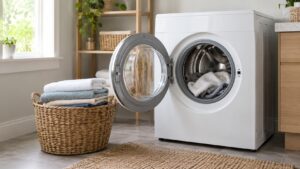
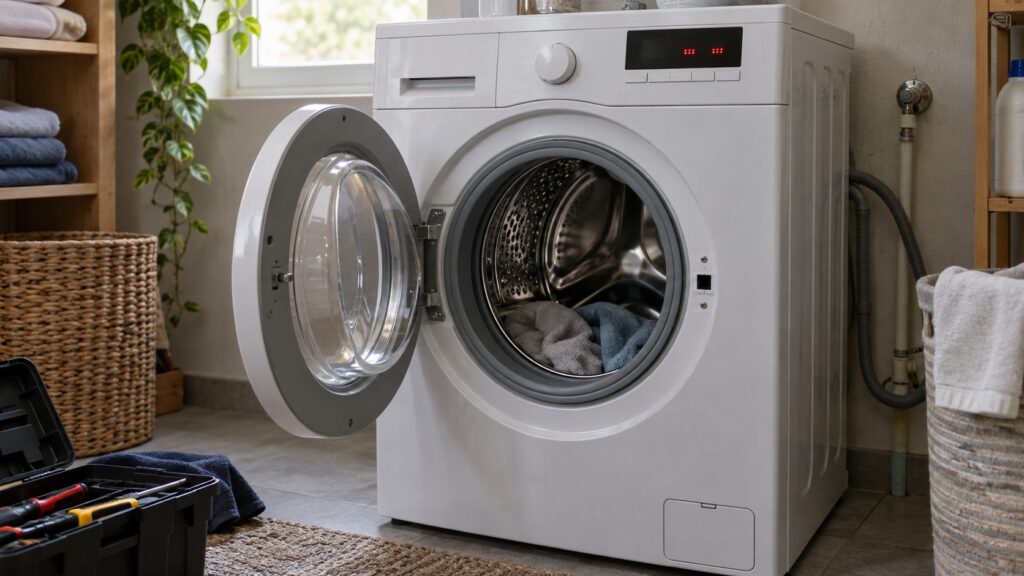
rL on an Amana front-load washer means a load was detected during a Clean Washer cycle. It is not a breakdown, it is not a part, and nothing needs to be replaced. The washer weighed the drum, found something in it, and stopped because the cleaning cycle is designed to run empty. The Amana washer rL code is the machine declining to do the wrong thing, which is why it is one of the very few codes you can clear in thirty seconds.
What does rL mean on an Amana washer?
Modern Amana front-load washers estimate the weight of what is in the drum before they commit to a cycle. They do it by driving the drum briefly and measuring how the motor responds — a heavy drum resists differently from an empty one. The reading sets the water level and the spin profile on an ordinary wash.
On the Clean Washer cycle the same measurement is used as a gate. That cycle exists to scrub the drum, the seal and the sump with a strong dose of chemistry and a long hot run. Anything fabric in there would be soaked in cleaner at a concentration no garment is meant to see. So when the weight check finds a load, the washer prints rL and waits.
Why does the Clean Washer cycle refuse to run with anything in it?
Because the cycle is not a wash. It runs hotter and longer than a normal program, it uses far less water movement and far more dwell time, and it is meant to be used with a washer cleaning tablet or the dose of bleach the manual allows. It targets the biofilm that grows behind the door seal and in the sump, which is the same subject as our guide to an Amana washer that smells.
A towel left in there does two things, both bad. It absorbs the cleaner and keeps it off the surfaces that needed it, so the cycle accomplishes nothing. And it comes out carrying a concentration of chemistry that will not rinse fully in a cold cycle. The gate is there for the laundry, not for the machine.
The drum is empty and rL still appears — now what?
Look again, properly. In the order that finds it:
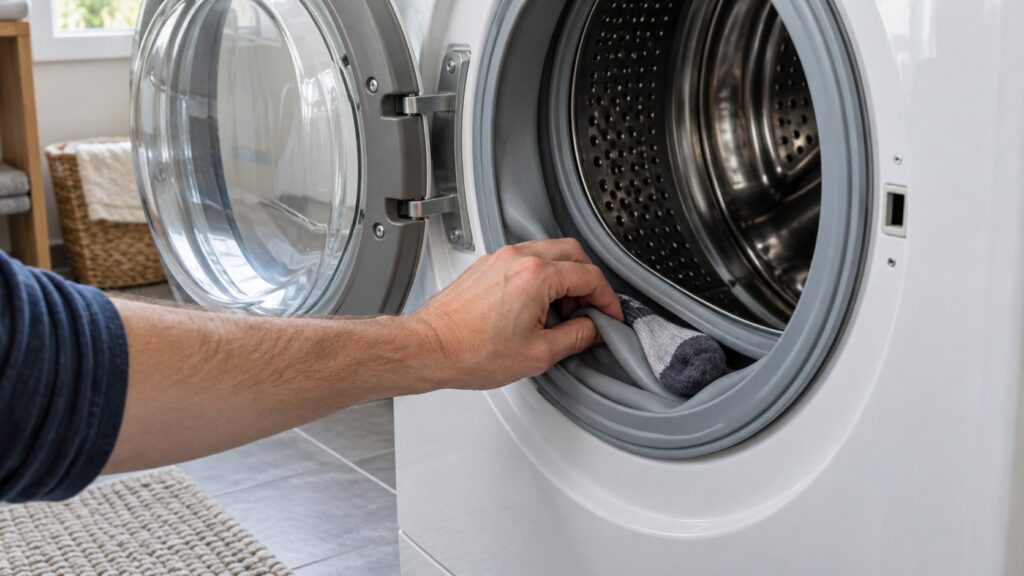
- Put your hand all the way around the door seal. A single sock folded into the bellows is the most common answer by a wide margin, and it is invisible from the front.
- Check the back of the drum with a flashlight. Small items migrate to the rear and sit flat against the wall.
- Check for standing water. Water is weight. A sump that has not drained fully reads as a load, and that points at a drain restriction rather than a forgotten garment — our page on an Amana washer that will not drain covers it.
- Make sure the machine is level and settled. A washer rocking on an uneven floor can spoil the weight measurement. The setup steps in our guide to leveling an Amana washer apply directly.
If all four are clear and rL keeps appearing on an empty, level, fully drained machine, the load-sensing measurement itself is suspect. That is a real fault, and it is the point at which the code stops being a prompt.
How is rL different from uL and oL?
All three come from the same weight and motion sensing, and people mix them up constantly. rL is about the wrong cycle: there is a load and the cycle wanted none. uL is unbalanced: the load is fine in total but gathered on one side, which shows up at the start of a spin and usually means one heavy item like a bath mat or a comforter. oL is overload: there is simply more in the drum than the program can move.
uL and oL are fixed by opening the door and redistributing or removing. rL is fixed by emptying completely. None of the three is a repair, and none of them should be cleared by repeatedly pressing start — a washer that is told four times to spin an unbalanced load is a washer working its suspension for nothing.
Which Amana washer codes are prompts and which are failures?
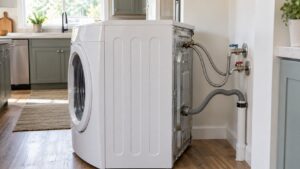
The two-letter codes are mostly prompts about a condition: rL, uL, oL, Sd for a suds lock from excess foam, LF for a long fill, HC for hot and cold hoses reversed, DET for a detergent cartridge. HC is worth knowing because it turns up after an installation or a move and it is fixed with two wrenches at the back, not with a service call.
The paired F codes are the ones that name a system. F5 E3 is a lid lock failure, F7 E1 is a motor or drum drive problem, F8 E1 is a long fill and is the same condition as LF, F9 E1 is a long drain and is the same condition as Ld. When your washer shows both a letter code and an F pair for one event, they describe one fault. Our guide to the Amana code families sets out how the letters and the pairs relate across the whole brand.
One line in that list deserves its own warning. Sd, the suds lock, is caused by too much detergent or the wrong type far more often than by anything mechanical, and the cure is measurement rather than repair — see our guide to the Amana washer suds error.
How do you run the Clean Washer cycle so rL does not come back?
Empty the drum completely, including the seal. Add the cleaner the manual specifies, in the dispenser compartment it names, and nothing else — no laundry detergent on top, because foam during a clean cycle can trigger a suds lock and turn one code into two. Close the door, select Clean Washer, and leave it alone for the full run.
Once a month is the usual interval for a front-load machine in regular use, and it belongs alongside the other habits in our Amana washer maintenance guide: wiping the seal dry, leaving the door ajar between washes, and keeping the detergent dose honest. Do that and rL becomes what it should be — a code you see once, on the day you forgot to check the bellows.
When is it actually a service call?
When rL appears on a genuinely empty, level machine with no standing water, more than once. That means the load sensing is reading something that is not there, and the candidates are the drive, the control, or the way the two communicate. Do not remove the lower panel to look for water yourself: the pump and the drain hose sit on a live board in a wet compartment, and the door lock holds a drum that may still be full.
We are an independent repair company, not a factory service arm. Pricing starts from a diagnostic visit and we confirm the estimate before any work begins. Call 1-844-760-0459, see what Amana washer repair covers, or schedule a visit.