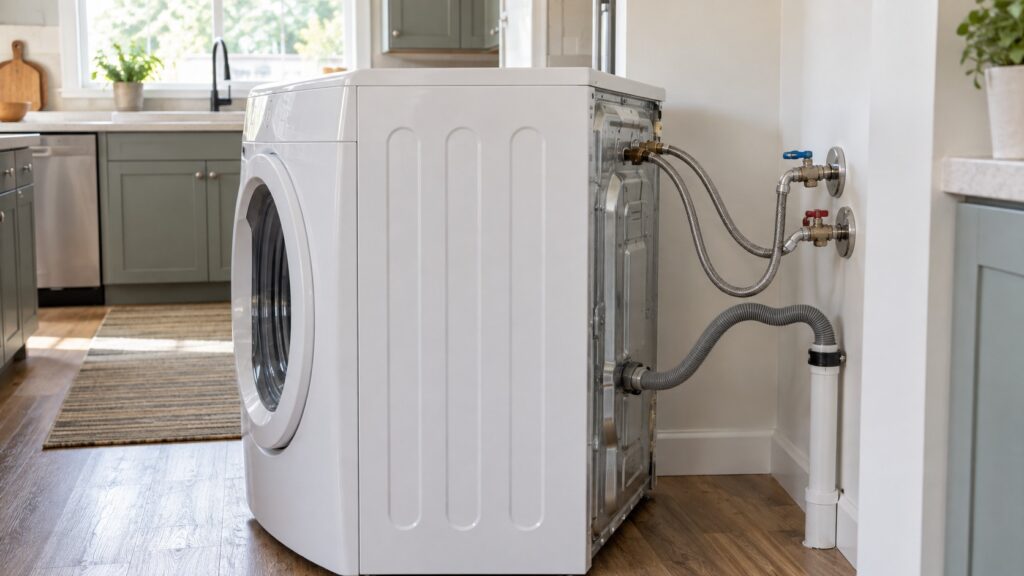
Amana washer installation is four connections and one measurement, and almost every problem that follows comes from getting the measurement wrong or treating one of the connections as a formality. A washer moves water under pressure, spins a heavy load at speed and sits somewhere that is often not designed to take either — which is why installation decides more about how a washer behaves than the model does.
The shipping bolts, first and always
A front-load washer ships with bolts or braces holding the drum rigid so it survives transport. They must come out before the first cycle, and the machine will run with them in — loudly, and while damaging the suspension it needs for the next decade.
Keep them. If the machine is ever moved again, they go back in, and moving a front loader without them is the other half of the same mistake. They live taped to the back of the machine or in the laundry room drawer, not in the trash.
Hoses: the cheapest insurance in the house
A burst washer hose is one of the most common sources of serious water damage in a home, and it happens because rubber hoses age quietly and fail all at once. Braided stainless hoses cost a little more and do not fail the same way. Fit new ones with a new machine — never reuse the old set, whatever their apparent condition.
- Hand tight plus a quarter turn. Overtightening distorts the washer at the valve and causes the leak you were preventing.
- Check the screens in the inlet valves. Debris from the supply lines collects there and shows up as a machine that fills slowly — see our page on a washer that will not start for related symptoms.
- Do not kink them. A machine pushed back hard against a rigid connection kinks the hose at the elbow, which is where it eventually splits.
- Turn the valves off if the house will be empty for a long period.
The drain is where most mistakes live
A standpipe has a specified minimum and maximum height for a reason. Too low and the machine siphons — water drains out as fast as it fills, and the cycle never completes properly. Too high and the pump cannot lift the water, which produces a drain fault on a perfectly good pump.
The hose has to be secured at the standpipe but not sealed into it: an air gap is required so waste water cannot be siphoned back into the machine. A hose jammed tightly into a pipe is a cross-connection, and it is also how a drain blockage sends water into the washer instead of onto the floor. Our page on a washer that will not drain covers the symptoms.
Leveling is not a finishing touch
A washer spinning a wet load at high speed is a balancing machine, and it relies on being level to balance. A machine that rocks on one foot converts that spin into movement across the floor, which is the complaint people describe as a washer walking. It also puts load into the suspension that will shorten its life.
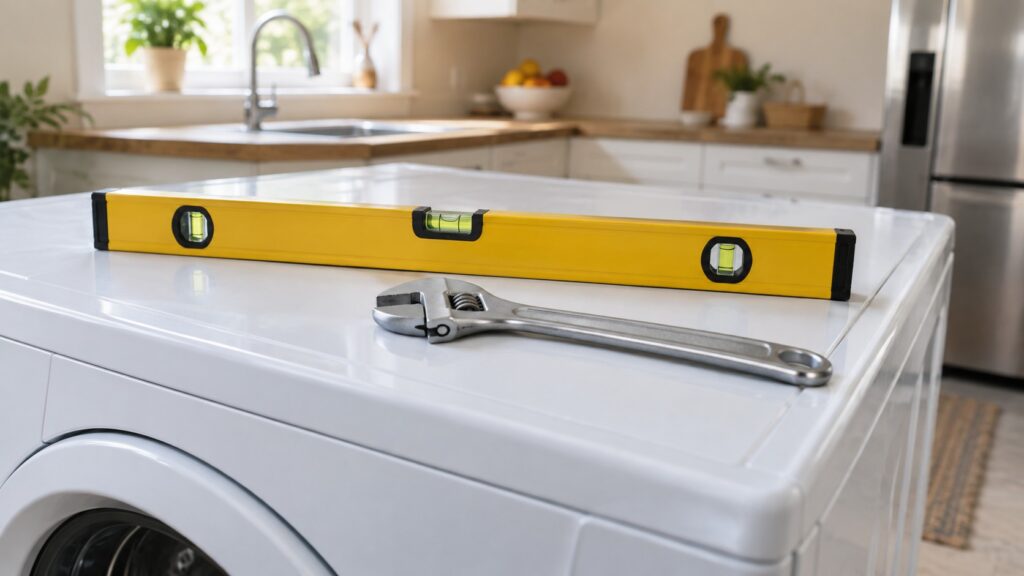
Level it front to back and side to side with a spirit level on the top, then push down on each corner in turn — nothing should move. Re-check after the first few loads, because a machine settles. Our leveling guide covers the feet and the lock nuts, and the page on a washer that walks covers what to do when it still does.
The floor matters as much as the machine
A solid slab absorbs spin vibration; a suspended wooden floor amplifies it, and a second-floor laundry room amplifies it into the rooms below. Nothing about the washer changes that. What helps is placing the machine over a joist rather than mid-span where possible, using anti-vibration pads, and accepting a lower spin speed if the alternative is a house that shakes.
This is also why a machine that was quiet in one home can be unbearable in another with no fault at all.
Stacking, and the clearances people forget
A stacked pair needs the manufacturer’s stacking kit — not brackets, not straps. The kit locates the dryer positively so it cannot walk off the washer during a spin. Check the ceiling height as well: a dryer on top of a washer puts its door opening at chest height or above, and loading it is a daily inconvenience if the room is tight.
Leave enough clearance behind for the hoses and the vent without crushing either. Our dryer installation guide covers the venting side.
Hot and cold, and the connection people reverse
Both hoses look identical and they are not interchangeable. A washer plumbed with hot and cold reversed does not fail dramatically — it simply washes everything on the wrong temperature, which shows up as cold washes that never get clean and delicate cycles that shrink things. Because nothing breaks, it can go unnoticed for years.
Check it at commissioning by starting a hot cycle and feeling the inlet hoses after a minute. If a machine is cold-fill only, there is one connection and the question does not arise; if it takes both, the connection is marked at the valve and worth verifying rather than assuming.
Commissioning, and when to call
Run one empty cycle before any laundry. Watch the fill, watch the drain, and put a hand on the connections while the machine is running — a weeping fitting shows itself in the first five minutes. Then run a small load and watch the spin from the side for movement.
We are an independent repair company, not an installer. What we see is the aftermath: shipping bolts left in, hoses reused, standpipes at the wrong height. If the machine is in and something is not right, Amana washer repair starts with a diagnostic visit, we confirm the estimate before any work begins, and you can schedule a visit online.