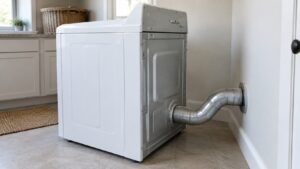
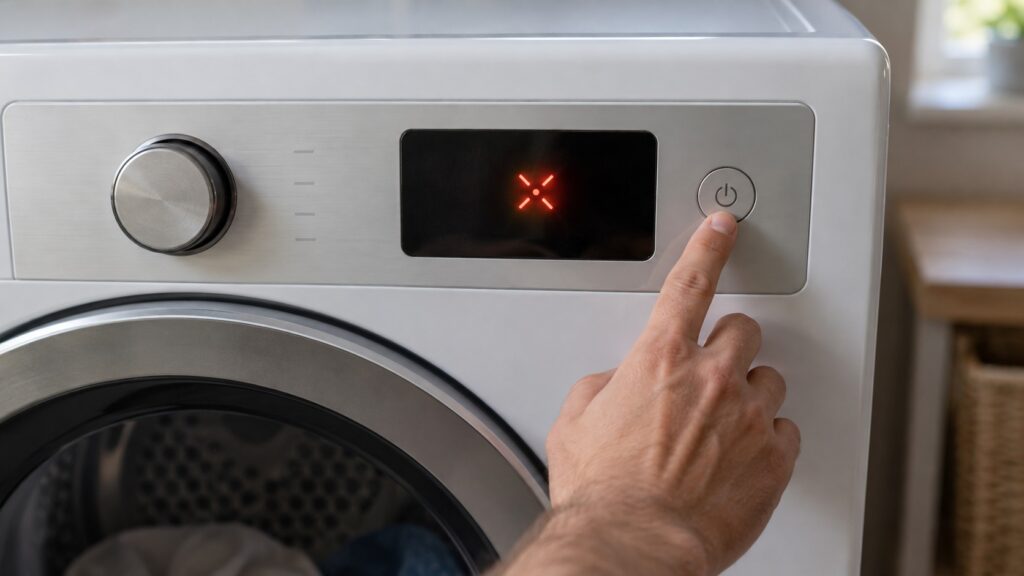
Amana dryer f70 f71 codes both point at a board-to-board communication problem on an older Amana dryer — the main control board and a secondary board (typically the user interface or a sensor board) have stopped talking to each other correctly, and F71 is a variant of that same underlying fault rather than a separate, unrelated issue. Both codes point at the connection and communication path between boards, not at the heating system or the motor.
What do Amana dryer error codes F70 and F71 actually mean?
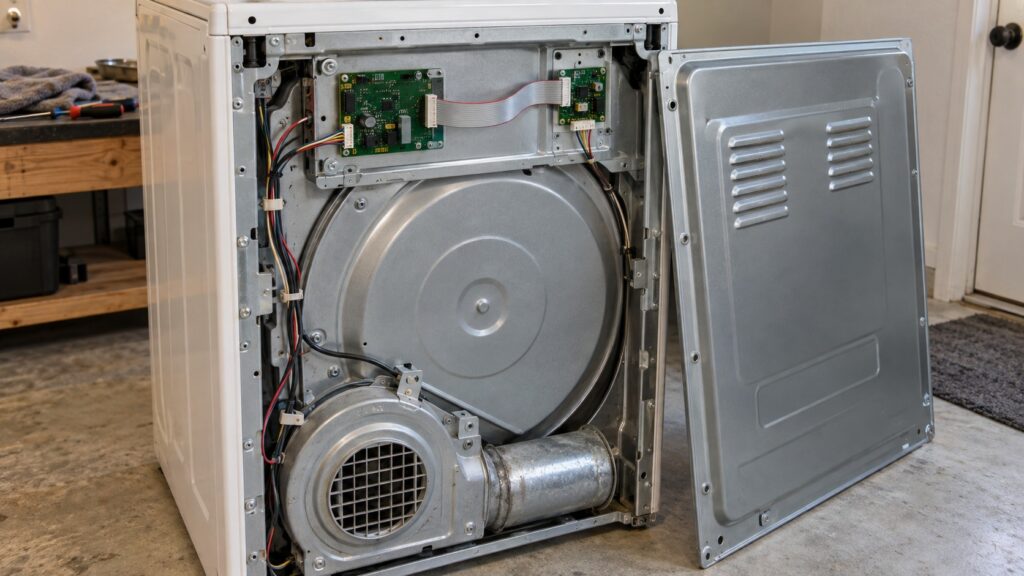
Older Amana dryers in this control generation split their electronics across more than one board rather than a single unified control — a main board handling the core cycle logic, and a secondary board typically tied to the user interface or a sensor system. Those boards constantly exchange signals to keep the dryer’s display, cycle timing, and safety systems synchronized, and when that exchange fails or becomes unreliable, the main board reports the fault as F70 or F71 rather than continuing to run on an assumption that the missing communication doesn’t matter.
Why are there two separate codes for what sounds like the same problem?
F70 and F71 both describe the same category of fault — the boards not communicating correctly — but they distinguish between slightly different failure signatures the control detects, such as a complete loss of communication versus a degraded or intermittent one. For an owner deciding whether to book a repair, the distinction between the two matters less than the fact that both point at the same connection and both call for the same kind of inspection once a technician is looking at it.
What typically causes this kind of board-to-board fault?
The most common cause is a loose, corroded, or partially disconnected ribbon cable or wire harness between the two boards — a connection point that has vibrated loose over years of normal dryer operation, or corroded slightly from humidity in the laundry room. Less commonly, one of the boards itself has developed an internal fault and is no longer sending or receiving signals correctly even with a solid physical connection, which is a different repair than simply reseating or replacing a connector.
What does this fault actually look like when it’s happening?
Symptoms vary depending on which board is affected, but commonly include a display that behaves erratically or goes blank, a dryer that starts a cycle and then stops unexpectedly, or controls that stop responding partway through normal use. Because the fault is about communication rather than heating or tumbling directly, the dryer may still run mechanically for a period before the control catches the communication failure and halts the cycle with the code displayed.
Can you check anything yourself before booking a repair?
You can safely power cycle the dryer — unplug it for a couple of minutes and restart — since an intermittent connection issue sometimes clears temporarily after a fresh restart, though it is likely to return if the underlying connector or board issue hasn’t actually been fixed. Beyond that, inspecting and reseating the connectors between boards requires opening the dryer’s cabinet, which sits close to internal wiring, and is where we recommend stopping and booking a proper diagnostic rather than continuing to open panels without training.
Is this an expensive repair on an older dryer?
Reseating or replacing a connector is an inexpensive, straightforward fix once diagnosed; replacing an actual failed board costs more but is still a well-defined, moderate repair rather than one requiring the kind of specialized handling a sealed refrigerant system needs. On a dryer already showing multiple age-related issues, weigh this repair against our broader Amana dryer repair or replace guide before committing to a specific part order.
What should you do while waiting for a repair visit?
Avoid repeatedly restarting cycles hoping the fault resolves itself, since a genuinely failed connector or board will not fix itself with repeated attempts and doing so mostly just delays getting an actual diagnosis. If the dryer stopped mid-cycle with damp clothes inside, move them to another dryer or hang them to air dry rather than leaving them sitting in a drum that may not finish the cycle reliably. Our guide on an Amana dryer that won’t start covers a broader range of startup faults if the symptoms you’re seeing don’t match a board communication issue specifically.
How urgent is an Amana dryer F70 F71 fault, really?
There is no fire or safety hazard built into either code on its own — an Amana dryer F70 F71 fault is the control system flagging a communication problem, not a heating or electrical hazard condition, so there is no need to treat the dryer as unsafe to leave plugged in while you wait for a repair visit. The urgency is practical rather than safety-driven: an unreliable control means you cannot count on a cycle finishing normally, so it is worth confirming loads before you leave the house rather than assuming the dryer will run to completion unattended. A dryer that has shown either code more than once in a short span is also worth booking sooner rather than later, since a communication fault that keeps returning after a power cycle is telling you the underlying connector or board has drifted further from a reliable state, not that the issue is resolving on its own between occurrences.
Does the age of the dryer change whether this repair is worth doing?
Mostly not, as long as parts are still available for your specific model. A board-to-board communication fault is a contained electrical issue rather than a sign of broader mechanical wear, so an otherwise healthy older dryer with good bearings, a solid belt, and no other recurring complaints is usually still worth repairing rather than replacing outright over this one fault. Where age matters more is parts sourcing: a control board for a model old enough to be out of active production can take longer to find or cost more than the board itself would on a current model, and that sourcing difficulty, not the fault itself, is what occasionally tips the decision toward replacement on a genuinely old unit.
We are an independent repair company, not a factory service arm, and we will tell you when a repair is not worth doing. Pricing starts from a diagnostic visit and we confirm the estimate before any work begins. If your dryer is showing F70 or F71, our Amana dryer repair service can check the board connections and the boards themselves — you can schedule a visit online.