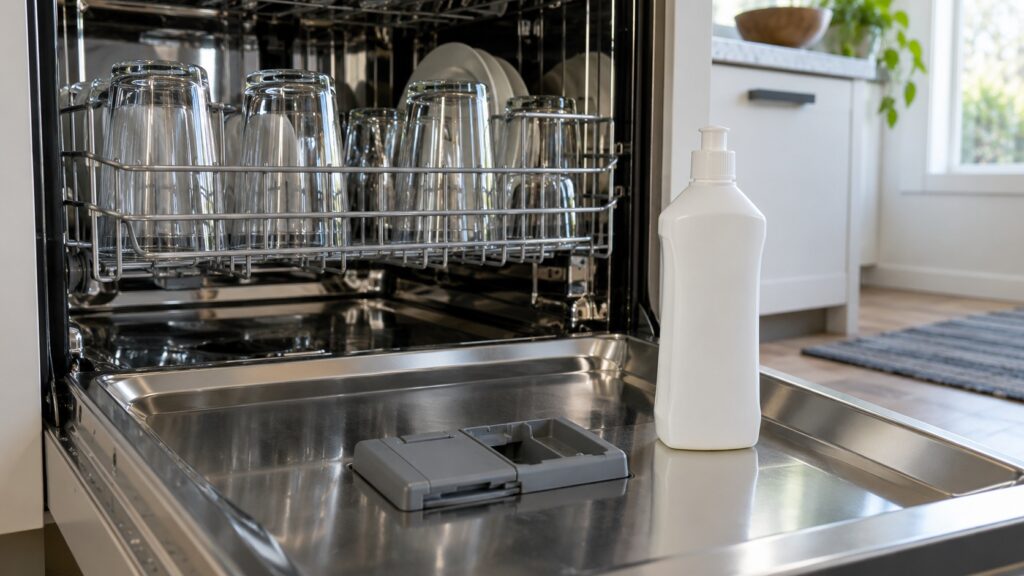
Amana dishwasher rinse aid is a liquid that changes how water behaves on dishes: it makes water sheet off surfaces during the final rinse instead of beading into droplets, and that is what lets glasses and plates dry clear instead of spotted. Our guides call keeping it topped up the biggest single factor in drying, and the most common reason a dishwasher leaves dishes wet is an empty rinse-aid dispenser. This guide covers how to use it, how to tell if you are running low, and the safe checks when drying or spotting does not improve.
What does rinse aid do in an Amana dishwasher?
Drying is when a film is deposited. As the final rinse water evaporates off a glass, whatever was dissolved in it stays behind as spots, and water that beads up leaves more spots than water that runs off in a thin sheet. Rinse aid lowers the water’s tendency to bead, so it drains off the dish in a sheet and the dish dries clean. Our guide to how Amana SoilSense works says the same: rinse aid does most of the work in hard-water homes, because it changes how water sheets off a surface as it dries. It also helps water sheet off the optical sensor window that the dishwasher uses to judge how dirty the wash water is.
How do you add rinse aid to an Amana dishwasher?
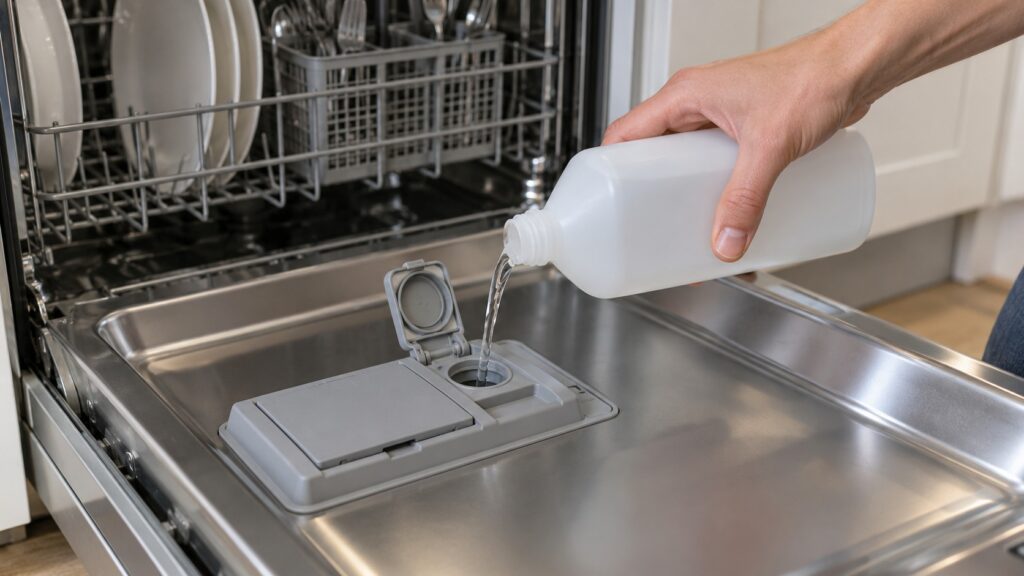
The exact location and cap style differ by model, so check the owner’s manual for yours. The general approach is the same. Open the door, find the rinse-aid compartment on the inner door, which is separate from the detergent cup, and open its cap. Pour in rinse aid until it reaches the fill line or indicator your dishwasher shows, close the cap firmly and wipe up any drips. Spilled rinse aid can make suds on the next cycle, so wipe it away. Use a product made for dishwashers, and follow the instructions on its bottle. Many dishwashers also have an adjustment for how much rinse aid is released; whether yours does, and how it is set, is in the manual, and we will not give a setting that our pages do not list.
How can you tell when the dispenser is empty?
- Dishes come out wet or with large water droplets, especially glasses and plastics.
- Spots and a cloudy film appear on glassware.
- A dispenser window or indicator on the cap, if your model has one, shows empty. The manual says what yours looks like.
- The compartment is dry when you open it and look.
Our Amana dishwasher not drying guide puts it plainly: refill the rinse-aid dispenser first, because it is the biggest single factor in drying.
What else affects drying besides rinse aid?
Rinse aid is one of four things. The Heated Dry Option has to be selected on models that have it, and the High-Temperature Wash Option or Sani option, if you want it, has to be chosen too. The water should be hot when it reaches the dishwasher, so our guides suggest running the kitchen tap hot before you start. Plastics hold little heat and stay damp however much rinse aid you use. And an overloaded rack blocks water and steam. Our guide also suggests opening the door a crack at the end of the cycle to let steam escape. If dishes stay soaked even with rinse aid and Heated Dry on, the cause may be a vent fan or heater, and that needs a technician.
Can you use too much rinse aid?
Yes, in two ways. A compartment filled past the line can release more than the cycle needs, which leaves a sticky film or causes foam on the next wash. And a heavy film on glasses is often mistaken for hard-water scale. If glassware looks cloudy and a dishwasher cleaner cycle does not help, try cutting back, and read the manual to see whether your model lets you adjust the release. For limescale, our Amana dishwasher maintenance checklist suggests running a dishwasher-cleaner or vinegar cycle to clear grease and scale, and wiping the door gasket and tub edge.
When should you call a technician?
Call when the dispenser does not release rinse aid, when dishes stay wet with rinse aid, Heated Dry and hot water all in place, or when the dishwasher shows a code. Do not remove the inner door panel or the dispenser housing to look for a fault; that is a technician’s job. If water leaks near the door or the electrical parts, switch off the breaker at the panel while standing on a dry floor. Our Amana dishwasher repair page explains how a visit works.
What other habits keep glasses clear?
Rinse aid works best when the rest of the routine is sound. Scrape plates instead of rinsing them spotless: our loading guide explains that the dishwasher’s sensor judges how dirty the water is, and a nearly clean load makes it run a lighter wash than the dishes deserve. Rinse the Triple Filter Wash System regularly so soil does not recirculate, and load so that nothing blocks the spray arms from turning. Hard water changes what clean looks like, so if spots persist in a hard-water home, treating the water supply can do more than any setting on the dishwasher. See Amana dishwasher loading tips for the full set of loading habits.