
An Amana dishwasher is worth repairing again when the two failures are unrelated — a drain pump this year after a door latch two years ago is just ordinary wear on two different parts, not a pattern. It stops being worth repairing again when the same system fails a second time, or when a second unrelated part fails within twelve months of the first: that combination is what actually predicts a third call, not the dishwasher’s age by itself. Is an Amana dishwasher worth repairing again? The question is not “is this one part cheap to fix” — a single part almost always is — it is whether this repair is part of a pattern or a coincidence.
Why does a second repair raise a different question than the first one?
The first repair on any dishwasher is answered by looking at one part: is a drain pump, a door latch, or a water inlet valve worth fixing on its own. Almost always, yes — those parts are inexpensive relative to a new unit, and our general Amana dishwasher repair or replace guide covers that first-failure math. A second repair changes the question, because now there is a data point about the machine itself, not just about one part. A dishwasher that needed one pump in eight years is behaving normally. A dishwasher that has needed two unrelated repairs in the last year is telling you something about its overall condition that no single part price can capture.
Does it matter whether the two failures are the same part or different parts?
Yes, and in opposite directions. If the exact same fault returns — a drain error that clears for a month and then comes back, or a door latch that was replaced and is now failing again — that is usually a sign the first repair addressed a symptom rather than the actual cause, and the fix is to diagnose more carefully, not necessarily to replace the whole dishwasher. If two different systems fail within a short window — a control board this spring, a wash motor bearing in the fall — that is a much stronger signal that the unit as a whole is reaching the end of its service life, because unrelated systems failing close together points at general wear rather than one bad part.
How much does the twelve-month window actually matter?
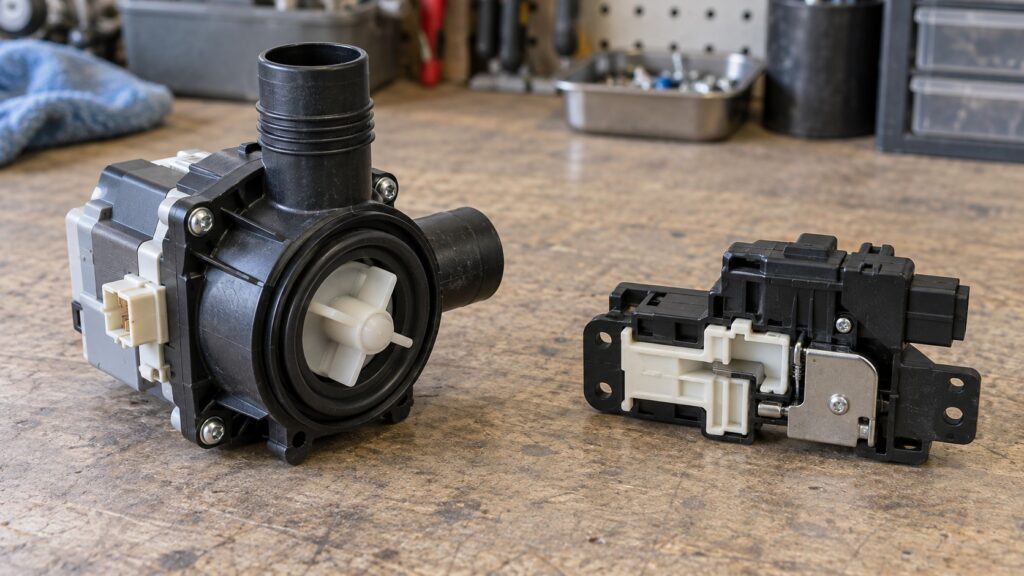
A lot. Two unrelated repairs spread across six or seven years is just what owning an appliance for that long looks like — nothing here suggests the dishwasher is failing as a whole. Two unrelated repairs inside twelve months is a different pattern entirely: components on the same appliance, built in the same era, sharing the same duty cycle and water quality, tend to wear out in clusters once the unit passes a certain age. If a second, unrelated part fails within a year of the first, treat that clustering as the actual signal, more than the dishwasher’s model year or how it looks on the outside.
What is the running-total math, and why does it beat looking at one invoice?
Add the current repair estimate to whatever you already paid for the previous one, and compare that combined number — not just today’s invoice — to about half the price of a comparably sized new Amana dishwasher. A single $180 pump replacement looks trivial in isolation. A $180 pump replacement stacked on a $220 control board repair from eight months earlier is $400 into a machine in under a year, and that total is the number that should drive the decision, not either bill on its own. Looking at repairs one at a time is the single most common reason people keep paying for a dishwasher that was already past the point of being worth it.
Are there failures that reset the clock, even on an older dishwasher?
Yes. A single, well-defined failure — a float switch, a door gasket, a heating element — on a dishwasher with no other repair history resets the clock regardless of the unit’s age, because it is an isolated event, not a pattern. An Amana dishwasher that is otherwise ten years old with a completely clean repair history and one new, unrelated fault is not in the same position as a four-year-old dishwasher on its second unrelated repair this year. Judge the pattern, not the birth year on the data plate.
What should you ask a technician before approving a second repair?
Ask directly whether this failure is connected to the last one, or genuinely unrelated — a technician who has actually opened the unit can usually tell you within a few minutes whether wiring, water quality, or installation is driving repeat failures across different parts, versus two coincidental part-level failures. Ask for the running total, in writing, of this repair plus whatever you paid in the last twelve months, so the comparison against a new unit’s price is based on real numbers rather than a guess made under time pressure with the kitchen out of a working dishwasher.
What is the safest default when the pattern is genuinely unclear?
When you cannot tell whether two failures are connected, default to repairing the specific part in front of you and start tracking repairs from that point forward — a written log of dates and costs turns “it feels like this thing is always broken” into an actual number the next time a part fails. Most single dishwasher repairs remain the right call even on a machine with one prior repair; the pattern this guide describes only tips toward replacement once a second, unrelated system fails inside that twelve-month window, or once the running total genuinely approaches half the cost of a new unit.
We are an independent repair company, not a factory service arm, and we will tell you when a repair is not worth doing. Pricing starts from a diagnostic visit and we confirm the estimate before any work begins. If your Amana dishwasher has failed more than once recently, our Amana dishwasher repair service can diagnose whether the two faults are connected before you spend on a second repair — you can schedule a visit online, and our Amana dishwasher buying guide is useful background if the running total tips toward replacing it instead.