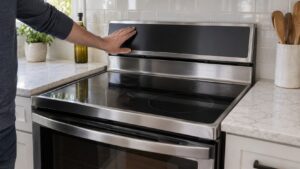
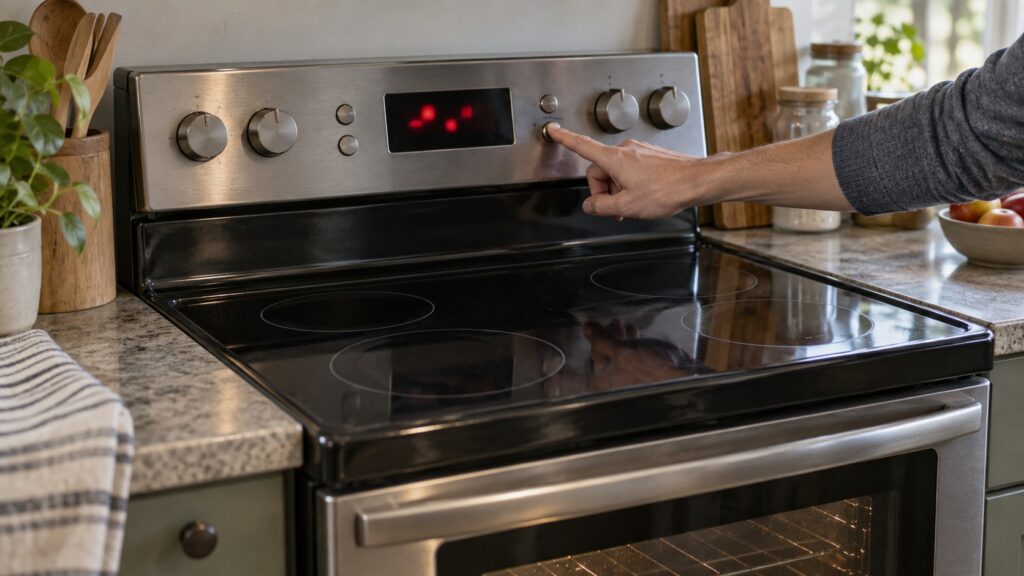
On a modern Amana range, F1 E0 is an EEPROM communication problem inside the control. The board has lost contact with the small memory chip that holds its calibration and settings, and rather than run an oven on numbers it cannot verify, the firmware stops the cycle and prints the code. That is the whole meaning of the Amana stove error code F1 E0: the control cannot read its own memory.
What does the Amana stove error code F1 E0 actually mean?
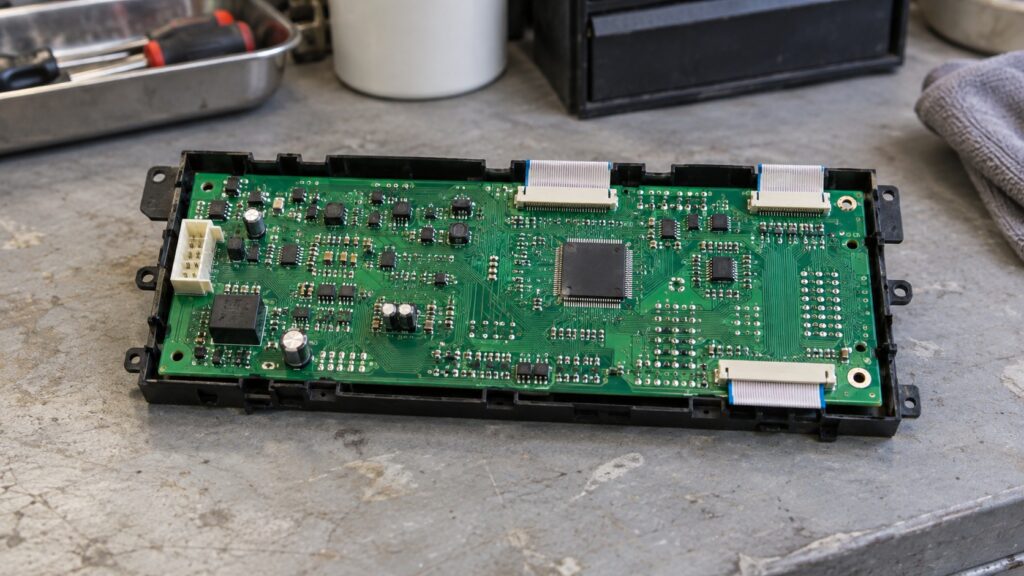
Every electronic range control carries two kinds of memory. The program itself is fixed, and beside it sits an EEPROM — a chip that keeps the things that must survive a power cut but can still change: the calibration offset for the oven sensor, the model configuration, the self-clean parameters, the preferences you set.
At startup and at intervals during a cycle, the processor reads that chip. F1 E0 is raised when the read fails or comes back corrupted. The processor is not reporting an oven fault at all. It is reporting that it no longer trusts the numbers it would have to cook with, and stopping is the correct response.
This matters for diagnosis because it eliminates a long list of suspects. An F1 E0 on an Amana range is not the temperature sensor, not the bake element, not the door latch, and not the thermal cutoff. Testing those is time spent on parts that were never accused.
Is F1 E0 the same as the older Amana F1 error?
No, and this is the part that sends people to the wrong repair. Our code pages keep them apart deliberately. A bare F1 on an older Amana range is a control board or watchdog problem — the processor failing its own supervision check. F1 E0, with the second character group, belongs to a later control generation and points specifically at the memory chip.
The two can look identical on a kitchen display if you glance at it, particularly on a panel where the characters alternate rather than showing together. If your range predates the paired codes and shows a single F1, read our guide to the Amana range F1 error instead. The same generational split runs through F2, F3, F5 and F9 on this brand, and our guide to reading Amana error codes lays the four families out side by side.
Will a reset clear F1 E0, and does that mean it is fixed?
A reset clears it often enough that it is always worth doing once. Switch the range off at the breaker, leave it off for five full minutes, and switch it back on. Five minutes matters: the control holds enough charge to keep its state alive through a short interruption, and a quick flick of the breaker only restarts the display.
What happens next is the diagnosis:
- The code never comes back. A power event corrupted a read, the control recovered, and there is nothing to repair. Note the date in case it repeats.
- The code returns within a day. The chip or its connection is degrading. This is a board job.
- The code returns immediately, before you can set anything. The read is failing every startup. This is a board job and the range is not usable.
- The code appears only during self-clean or only at high heat. Heat is reaching the control compartment. The board may be fine and the ventilation path is not.
That fourth pattern is worth taking seriously. A range that raises F1 E0 during a clean cycle and behaves the rest of the time has a cooling or clearance problem, and running clean cycles anyway is what finally kills the board. Our page on an Amana self-clean cycle that will not start covers the neighboring symptoms.
What causes an EEPROM fault on an Amana range control?
Three things, in roughly this order of frequency. Power events come first: a surge, a brownout, the changeover to a generator, or the sag that follows a nearby lightning strike. Memory reads and writes are the most fragile moment in a control’s life, and a voltage excursion during one can corrupt a stored value permanently.
Heat is second. The control on a freestanding range sits directly above the oven cavity, behind the panel, and it is cooled by a designed airflow path. Block that path — a backsplash pushed tight, a vent trim packed with grease, a foil tray laid across the oven vent — and the board runs hotter than it was built for, year after year.
Age is third and it is plain component wear. An EEPROM has a finite number of write cycles and the solder joints that carry its signals fatigue with thermal cycling. On a range that is twelve or fifteen years old, a memory fault is simply the board reaching the end.
Can I keep using the cooktop while the display shows F1 E0?
On most Amana ranges the surface elements are switched independently of the oven control, so the cooktop often still works while the oven refuses. That is convenient and it is not a reason to leave the code alone.
Two situations end that. If the oven heats while the code is displayed, or heats when you did not ask it to, switch the range off at the breaker and leave it off — a control that cannot read its calibration and is still driving the element is the one genuinely unsafe version of this fault. And if the display is dark, flickering or unresponsive along with the code, treat the whole control as suspect. Never bypass a latch or a switch to force a cycle past the code.
Is the control board worth replacing on an older range?
This is the honest question with F1 E0, because the repair is essentially one part and that part is the expensive one. A range control board is a bigger share of the appliance’s value than a sensor or a latch, and the labor is short.
Our rough rule is the one in our Amana range repair or replace guide: on a range under about eight years old with a sound cavity and a working cooktop, a board is worth doing. Past twelve years, with a door seal going and elements that have been replaced once already, the board is usually the last repair rather than the first. Prices start from a diagnostic visit and we give you the number for the part before you decide.
When should you call about F1 E0?
Call when the code survives a five-minute breaker reset, when it returns on a schedule, or when the oven heats with the code showing. Bring two facts to the call: whether the display shows F1 alone or F1 E0 as a pair, and the model and serial number from the tag inside the drawer or on the door frame, because range boards are matched to a model and a production range.
We are an independent repair company, not a factory service arm. Pricing starts from a diagnostic visit and we confirm the estimate before any work begins. Reach us at 1-844-760-0459, look at what Amana range repair covers, or schedule a visit online.