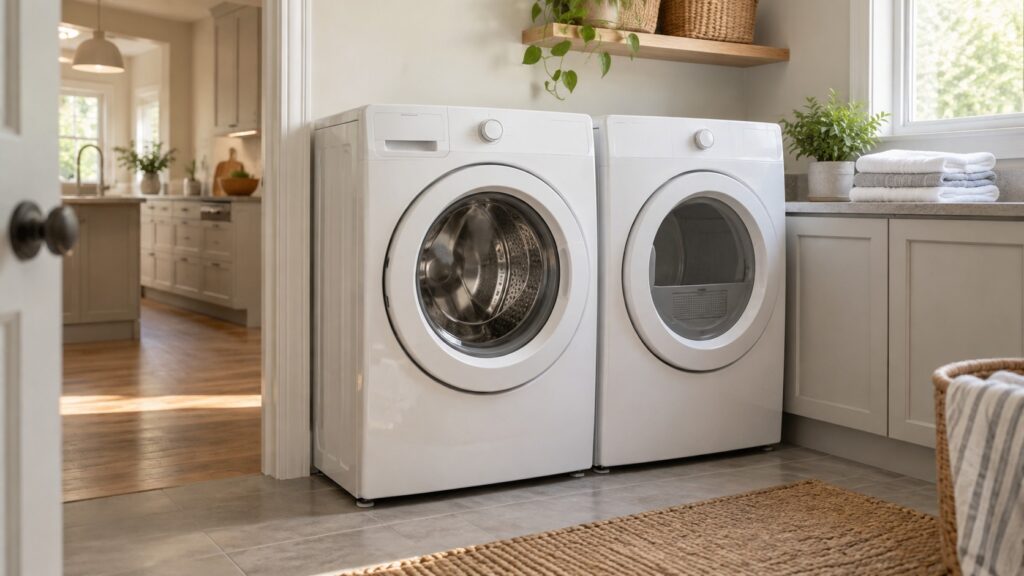
Washer capacity is quoted in cubic feet, and cubic feet is a number almost nobody can picture. Worse, it is the number people optimize for — buy the biggest drum that fits — when the right question is what you actually wash and how often. Getting Amana washer capacity right means fewer loads, better cleaning and a machine that is not being asked to do something it is bad at.
What capacity buys, and what it costs
A larger drum means fewer loads for the same laundry, which is the real benefit and a substantial one for a household that runs the washer daily. It also handles bulky items — a comforter, a sleeping bag, a mattress pad — that a smaller drum cannot wash properly at all, because they need room to move.
What it costs is time and floor space. A larger drum takes longer per cycle, uses more water per load even if less per pound, and needs a bigger footprint. A household doing three small loads a week gains nothing from a large machine except a longer wait each time.
The mistake that undoes the whole purchase
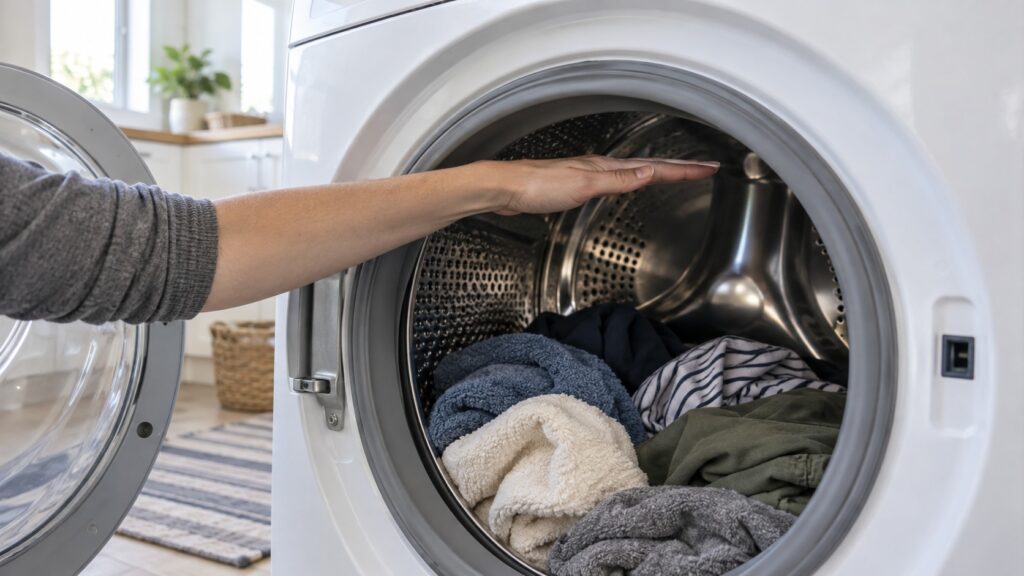
Clothes clean by moving through water and detergent. A drum packed to the top has nothing moving; the load rotates as a single mass and the middle never sees fresh water. That is why a large washer filled to capacity often cleans worse than a standard one filled sensibly, and why people who upgrade for capacity sometimes conclude the new machine is inferior.
The rule that works on any size: load to about three quarters, and be able to fit a flat hand between the top of the load and the drum. Our washer cycle guide covers matching the program to what is in there.
Measure the opening, not just the machine
- Doorways and turns. A full-size washer has to reach the laundry room. Measure the narrowest point on the route, including a turn at the top of a stair.
- Depth with the door open. A front loader needs its door to open fully in a room that may be narrow.
- Clearance behind for hoses and the drain standpipe. Pushing a machine back hard against a rigid connection is how leaks start.
- Stacking. If a dryer goes on top, check the pair is designed to stack — and check the ceiling height for loading the dryer.
Our washer installation guide covers the connections and the clearances in detail.
Top load or front load changes the arithmetic
The same cubic feet behave differently in the two formats. A front loader tumbles the load through a shallow pool, so it uses less water and can spin faster, which is why it hands over a drier load to the dryer. A top loader with an agitator loses some usable volume to the agitator itself; an impeller model recovers it.
Neither is better in the abstract, and our top load against front load guide covers the trade honestly. What matters here is that a quoted capacity is more usable in some formats than others, so comparing numbers across formats is not comparing like with like.
What you actually wash, counted honestly
Before comparing machines, spend a week noticing your own laundry. Count loads rather than estimating them, and notice what kind they are: a household whose washing is mostly small colored loads and delicates is served badly by a large drum, because those loads never fill it and a part-filled drum wastes a cycle. A household washing towels, bedding and work clothes fills a large drum easily and benefits immediately.
Two specific items decide more purchases than anything else. A king comforter needs room to move and is the single most common reason people wish they had bought larger. And pet bedding, which most people wash separately and frequently, argues the same way. If neither is part of your week, the standard size is almost certainly the right one.
Cycle time, and the trade nobody mentions
Larger machines take longer per cycle, and modern efficient machines take longer than the machines they replace regardless of size. A two-hour normal cycle is not a fault; it is how low water use and good cleaning are reconciled. The practical consequence is that fewer, larger loads do not always finish sooner than more, smaller ones — the arithmetic depends on how long each cycle runs.
Where it matters is scheduling. A household that washes in the evening and needs the load in the dryer before bed is better served by a machine that finishes predictably than by one that finishes in bulk. Quick-wash programs exist for exactly this, and they work well on lightly soiled loads of moderate size.
Spin speed is the number to ask about
Every gallon of water the washer removes is a gallon the dryer does not have to boil off. A higher spin speed therefore shortens every dryer cycle for the life of the pair, which is a larger running cost than anything capacity affects. If you are choosing between two machines of similar size, the faster spin is usually the better buy.
The trade is vibration. A fast spin needs a level machine on a solid floor, and on a suspended floor it needs more care — see our leveling guide and the page on a washer that walks.
Before you replace the one you have
A washer that will not drain, will not spin or has started leaking is very often a pump, a hose, a lid switch or a suspension component rather than an appliance at the end of its life. Those are ordinary parts. Our repair or replace guide sets out where the line sits, and the maintenance guide covers what prevents most of it.
We are an independent repair company, not a dealer, so we have nothing to sell you on the buying side. Amana washer repair starts with a diagnostic visit, we confirm the estimate before any work begins, and you can schedule a visit online.