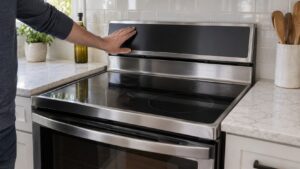
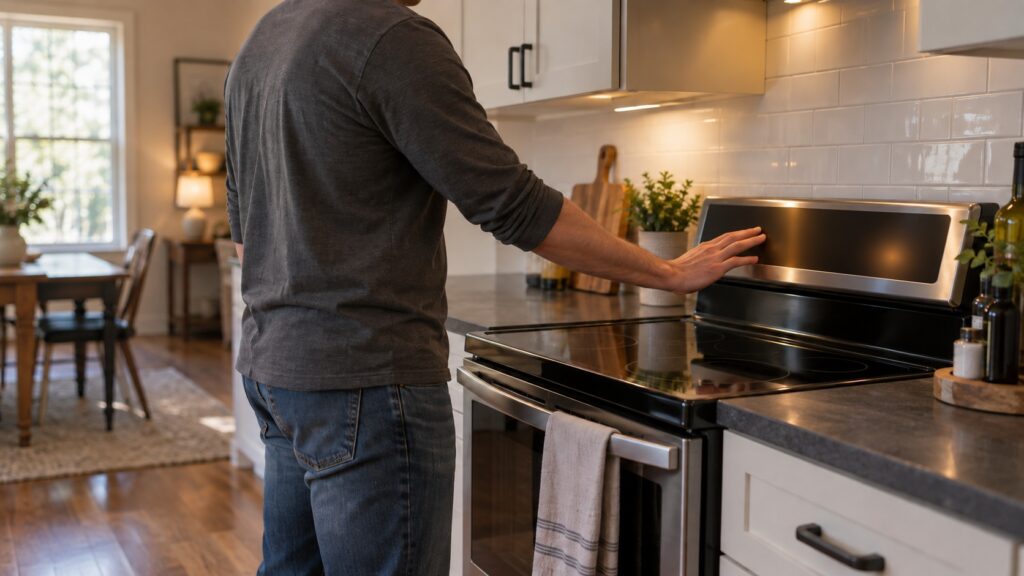
F2 E1 on a modern Amana range means the keypad ribbon is unplugged. The control board is not seeing the touch panel at the other end of a flat plastic ribbon cable, so it reports the disconnection and refuses to accept input. Anyone searching the Amana stove error code F2 E1 is looking at a connector problem between two parts, not at a failure of the oven itself.
What is the keypad ribbon, and why does the range stop for it?
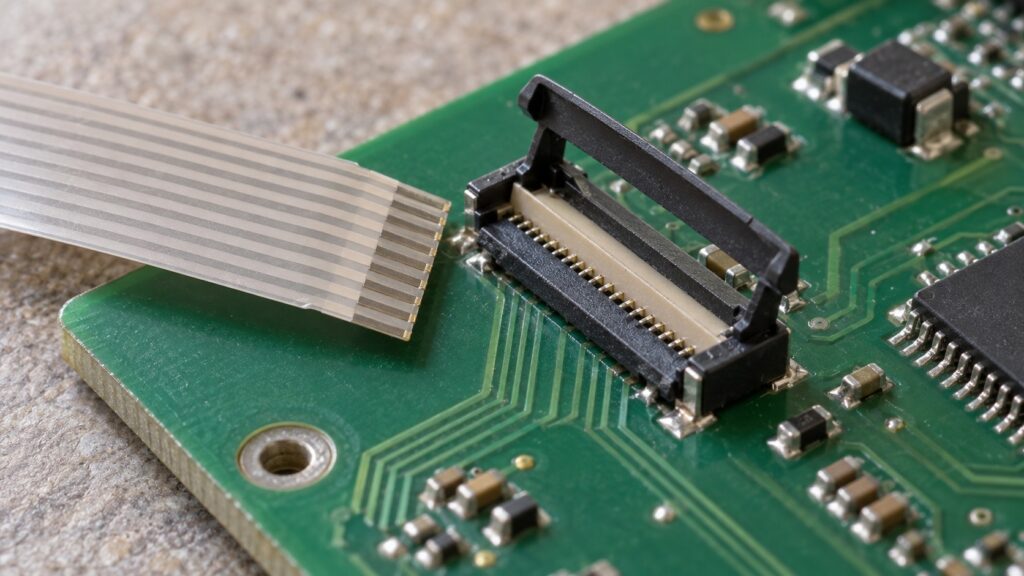
The buttons on a modern Amana range are not switches in the mechanical sense. They are a printed membrane: a sandwich of thin plastic layers with conductive tracks, where pressing a spot bridges two tracks. All of those tracks run out of the panel as a single flat tail, ten to twenty conductors wide, that folds around and pushes into a socket on the control board.
The board drives that matrix constantly, scanning the rows and reading the columns. If the pattern it gets back is impossible — every column reading the same, or nothing reading at all — the only sane conclusion is that the panel is not connected. It raises F2 E1 and stops, because a control that cannot tell whether you pressed Bake or Self Clean has no business heating anything.
Why is a bare F2 a different and more serious code?
On an older Amana range, F2 with nothing after it is an oven over-temperature or runaway condition. That is not an input problem. It is the control reporting that the cavity got hotter than it should have, and it is the one range code that deserves an immediate power-off at the breaker rather than a restart.
The paired F2 E1 belongs to a later generation and carries none of that weight. Same leading character, completely different subject, and the whole difference is the second group on the display. Amana splits F1, F3, F5 and F9 the same way, which is why our guide to the Amana error code families starts with the shape of the code rather than its meaning. If your display shows F2 alone and the oven has been running hot, stop using it.
Why do a few buttons fail before the code appears?
Because a ribbon rarely pops out all at once. What usually happens is that the tail loosens by a hair in its socket, or oxidation creeps along a few of the contact pads at one end. The conductors at the edge of the ribbon lose contact first, and in a keypad matrix a lost column takes out a vertical strip of buttons.
That is the classic Amana story told backwards: the number 3 and the Timer stopped working months ago, then Bake became unreliable, then one morning the panel showed F2 E1. If the buttons that failed sit in a line rather than scattered at random, the ribbon or its socket is the suspect and the panel itself is probably fine.
Scattered dead keys mean something else. A membrane that has been cooked by steam and grease at the vent, or one that was cleaned with an abrasive pad, fails in patches wherever the layers separated. That is a panel replacement, not a reseat.
What unplugs a ribbon in a range that nobody touched?
Most often, somebody did touch it. The keypad ribbon is the first thing disconnected and the last thing reconnected in any repair that opens the control panel — an element change on some layouts, a board swap, a display replacement. A tail that was pushed back in without the retaining latch closed sits there working for weeks and then walks out under vibration.
Moving the range does the same thing. The ribbon is the only part of the panel assembly that is flexible, so it absorbs every shock the cabinet takes. A range dragged across a threshold or tipped onto a dolly is a range whose ribbon has been flexed.
The slow cause is the oven vent. On most Amana ranges the hot air leaves the cavity through a slot directly under the control panel, and grease-laden steam from roasting goes straight up over the ribbon socket. Over ten or twelve years that leaves a residue that insulates the contacts. Wiping the vent trim when you clean the cooktop is, genuinely, ribbon maintenance — the same logic as the upkeep in our Amana range maintenance guide.
Is it the ribbon, the panel, or the board?
A technician separates the three in about ten minutes with the panel open and the power off. The ribbon is checked visually for creases, for pads worn through to the plastic, and for a tail that is not fully home in a latched socket. The panel is checked by substituting a known one or by reading the matrix. The socket on the board is checked for a spread or corroded contact and for heat damage around it.
The reason the order matters is cost. Reseating a good ribbon in a clean socket is a visit. A touch panel is a moderate part on most Amana ranges. A control board is the expensive end, and it is the wrong part to buy first when the code literally names the connection. If the range is old enough that you are weighing the spend at all, the frame in our repair or replace guide applies here as well.
What can you check without opening anything?
- Cut the power for five minutes at the breaker, not just at the panel. A control that comes back with the code still showing has a real disconnection; one that comes back clean had a read error.
- Map the dead keys. Press every button and write down which ones respond. A straight line of failures points at the ribbon; a random scatter points at the membrane.
- Look at the vent trim under the panel for heavy grease, and clean it cold with a damp cloth and dish soap. Nothing abrasive and nothing sprayed into the slot.
- Note whether a recent repair or a move preceded the code. That single fact changes the likely part.
Stop there. The control compartment of a range carries 240-volt connections within an inch of the ribbon socket, the panel on many models is retained by clips that break rather than bend, and a membrane tail creases permanently if it is pulled at the wrong angle. This is the point where the job becomes ours rather than yours.
When should you call?
Call when F2 E1 survives a breaker reset, when keys have been failing progressively, or when the code turned up after somebody worked on the range. Have the model and serial number ready from the tag on the door frame or in the storage drawer, because touch panels are matched to the exact model and finish.
We are an independent repair company, not a factory service arm. Pricing starts from a diagnostic visit and we confirm the estimate before any work begins. Call 1-844-760-0459, see what Amana range repair covers, or schedule a visit.