Amana washers series and lineup
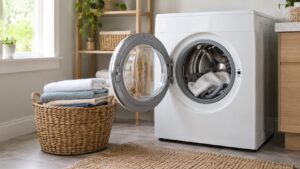
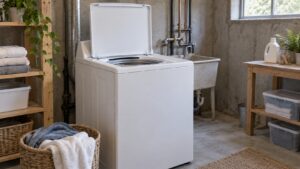
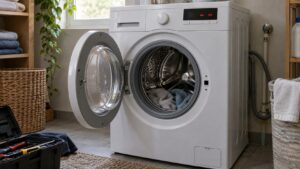
Amana washers are the brand’s value-built laundry, sold in two families that fail and get repaired differently. Top-load (NTW) models such as the NTW4519JW and NTW4516FW use a Dual Action Agitator or a High-Efficiency Agitator over a Porcelain Tub, with the Deep Water Wash Option for a full-immersion wash. Front-load (NFW) models such as the current NFW5800HW tumble the load against the drum, with prior-generation NFW5800DW and NFW7200TW also serviced as repair-lookup work. The two designs use overlapping but distinct code sets, so the configuration is always confirmed before any part is ordered. You can review the current washer range on the manufacturer’s site at amana.com and the models we service in our model directory, while step-by-step help is gathered in our repair guides.
Technologies and features
Amana washers keep laundry simple and durable. On a top-load NTW the Dual Action Agitator moves clothes through the water for a thorough clean, the Deep Water Wash Option fills the tub fully for heavily soiled loads, the Porcelain Tub resists wear, and the Late Lock Lid lets you add a stray item early in the cycle. A High-Efficiency Agitator appears on some builds for a lower-water wash. Front-load NFW models add a tumbling drum action and a detergent system, using less water and spinning faster so loads come out drier. The two designs are mechanically quite different, which is why the diagnosis always begins with confirming the configuration: a top-load has a lid, a lid lock, and on many builds an agitator and shifter, while a front-load has a door, a door lock, a rubber boot, and a drain-pump filter behind a kick panel. Because the design is practical rather than feature-heavy, the parts that wear are the water inlet valves, the drain pump, the lid-lock assembly on a top-load or the door-lock on a front-load, the drive system and shifter, the motor and motor control, the pressure and temperature sensors, and the suspension or shock absorbers — all matched to the specific NTW or NFW build. The model and finish suffix point the technician to the exact part, so confirming the model number saves a wasted trip.
Common issues and maintenance
Amana washers report genuine F#E# codes plus a set of lettered aliases. On a top-load the verified set includes F8 E1 (long fill, also LF or LO FL), F9 E1 (long drain, also Ld), F5 E1/F5 E2/F5 E3 (lid switch and lock), F0 E5 (off-balance, also uL), F0 E2 (too many suds, also Sd or Sud), F0 E3 (overload, also oL), F7 E1 (motor or drum), and F1 E1/F1 E2 (control and motor control). The official mapping is F0 E2 = suds, F0 E3 = overload, F0 E5 = off-balance — and many of these are load or setup conditions, not failed parts: an off-balance, suds, or overload is usually fixed by adjusting the load or detergent, and LOC or LC is the control lock, a feature cleared by holding the indicated button. On a front-load, F5 E2 means the door will not lock, F8 E1 a water-supply problem, and F9 E1 a drain problem; a dET message is a detergent-cartridge prompt, not a hard problem. A long-fill F8 E1 sends the diagnosis to the supply valves, the hoses, and the inlet screens; a long-drain F9 E1 to the pump filter, the drain hose, and the pump; and an F7 E1 to the drive system, motor, and shifter before the costly motor control is ever replaced. Reading the code correctly often saves a repair entirely, because so many of these codes describe a load or setup condition. Routine care helps: do not overload, use only the recommended high-efficiency detergent in the right amount, clean the drain-pump filter on a front-load, run an occasional clean cycle, check the fill hoses are not kinked, and leave the door or lid ajar between washes to air out and protect the gasket. For meanings and next steps, see our Amana washer error codes and our repair guides.
When to call for repair
Water inlet valves, drain pumps, lid-lock and door-lock assemblies, drive systems and shifters, motors, and control boards are best handled by experienced technicians who can read the F#E# code or lettered alias and, just as importantly, tell a genuine part failure from a load or setup condition before any part is fitted. As an independent, third-party service our skilled technicians fit genuine OEM parts from trusted parts suppliers and back every visit with a 30-day labor warranty on the workmanship. Note the exact code or alias and your NTW or NFW model number when you book. A clear quote is given before work begins and the total depends on the diagnosis — pricing starts from a trip-and-diagnostic fee, and we never quote a fixed repair price sight unseen. Schedule Amana washer repair or book an appointment online.