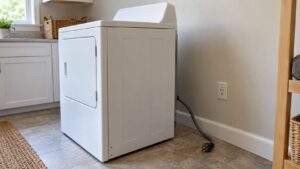
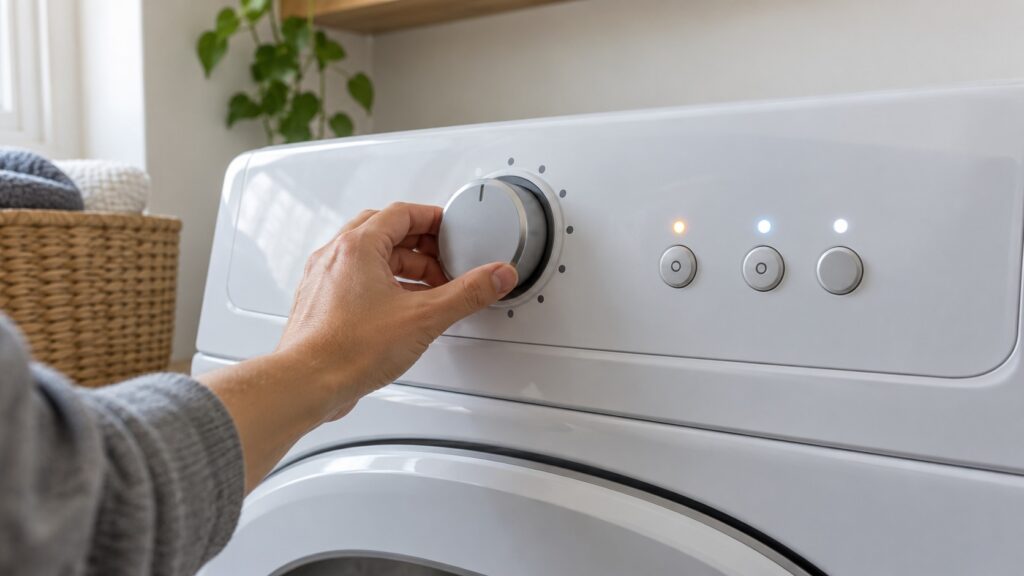
Amana dryer dryness terms come down to a handful of names you meet on the control panel and on a model page: Automatic Dryness Control, the AutoDry System, the dryness level, a timed cycle and the Wrinkle Prevent Option. The first three describe one idea, a dryer that judges when clothes are dry instead of running a fixed clock. This glossary explains each term in plain language, says where our pages stop describing it and points you to the owner’s manual for the exact behavior on your model.
What does Automatic Dryness Control mean on an Amana dryer?
It means the dryer does not simply run until a timer runs out. Our NED4655EW page lists Automatic Dryness Control with the AutoDry System as the dryer’s drying method. The control watches the load and stops when the clothes reach the dryness you picked. Amana dryers fall into two groups: electronic-display NED and NGD models, and budget mechanical-timer models with no display. The moisture-sensing terms belong to the first group, so if your dryer has a plain timer dial, some of the words in this glossary will not appear on it.
How does the AutoDry System sense dryness?
Our guide to how Amana dryer moisture sensing works says the system uses two metal sensor bars inside the drum to detect when clothes stop conducting moisture. Wet fabric carries a small electrical signal between the bars and dry fabric does not, and the control reads that difference. It judges dryness electrically, not by a clock, which is why the same load can take a different time on different days. A film of fabric-softener residue on the bars can fool it, and so can a clogged vent, so a cycle that ends early or runs on is often not a fault in the sensor.
What does the dryness level setting do?
The dryness level is the instruction you give the sensor. Our AutoDry guide says most Amana dryers with the feature offer a few options, such as more damp for ironing and fully dry for storage, and that choosing the wrong one makes the sensor look inaccurate when it is following the setting. The labels differ from one panel to another, so read yours. If clothes come out slightly damper than you like, change the level before you suspect the sensor. The Amana AutoDry tips go through the habits that keep readings accurate.
What is a timed dry cycle and when would you use it?
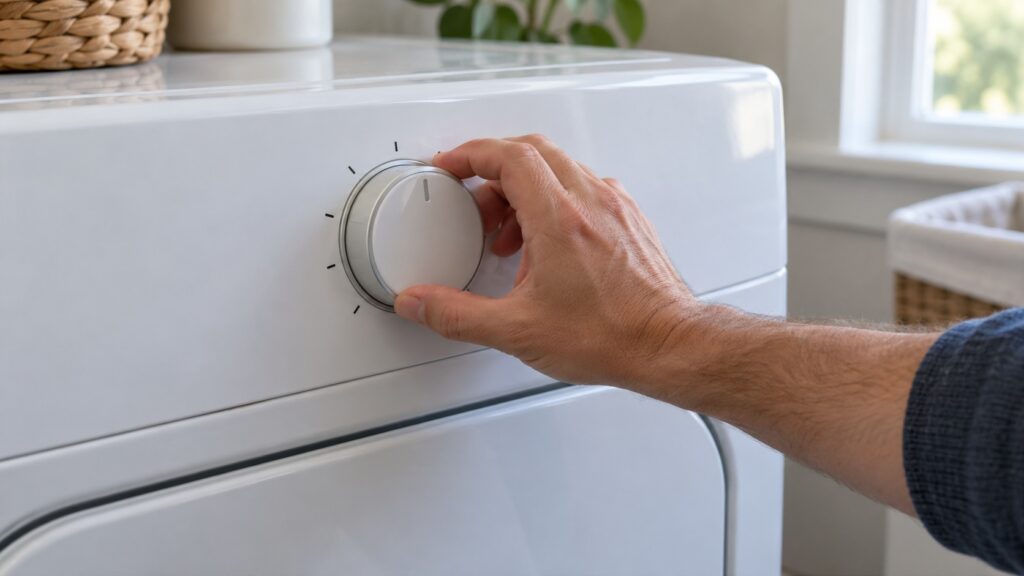
A timed dry cycle runs for the length you set and ignores the sensor. It suits a single bulky item, a pair of boots or anything the sensor cannot read well, and it is the fallback if you suspect the sensor bars are dirty. The risk is the opposite of the automatic cycle: it will keep drying a load that is already dry, which wastes energy and can wear fabric. We do not give times, because the right length depends on the load, the dryer and the vent, so use your manual and the feel of the clothes. Our Amana dryer takes too long guide covers the case where the dryer is running much longer than it should.
What is the Wrinkle Prevent Option?
Our NED4655EW page lists the Wrinkle Prevent Option beside Automatic Dryness Control, and the page does not describe what it does. In general, features with that name are meant to cut down on creases when clothes sit in the drum after the cycle ends, but whether yours tumbles the load, adds heat or does something else, and for how long, is a question for the owner’s manual. Do not assume the behavior from another brand. Our Amana dryer drying tips cover everyday loading habits, which affect wrinkles more than most settings.
What should you check when the dryness terms do not seem to work?
- The setting. Is the dryness level the one you meant?
- The sensor bars. Residue from dryer sheets is the usual culprit; our AutoDry guide suggests wiping them every few months with a cloth lightly dampened with rubbing alcohol, done with the dryer off and the drum completely cool.
- The load. An overloaded drum stops clothes tumbling past the bars.
- The vent. A restricted vent can make the sensor read wet long after the clothes are dry; see how to clean an Amana dryer vent.
If the dryer shows a restricted-airflow or low-voltage code, or a heat problem, the dryness setting is not the cause. Do not open the cabinet to look at the sensor wiring or the heating parts; that is a technician’s job.
When should you call a technician?
Call when the dryer ends cycles far too early or far too late after the bars are clean and the vent is clear, when a code appears and returns, or when the dryer will not heat. If you smell burning, stop using the dryer, and if there are sparks or the cord or outlet is wet, switch off the breaker at the panel while standing on a dry floor. Our Amana dryer repair page explains how a visit works.