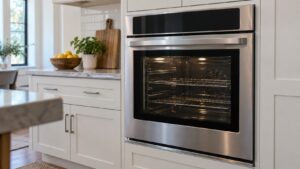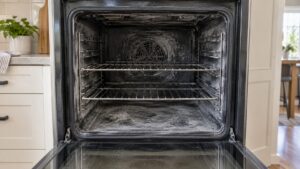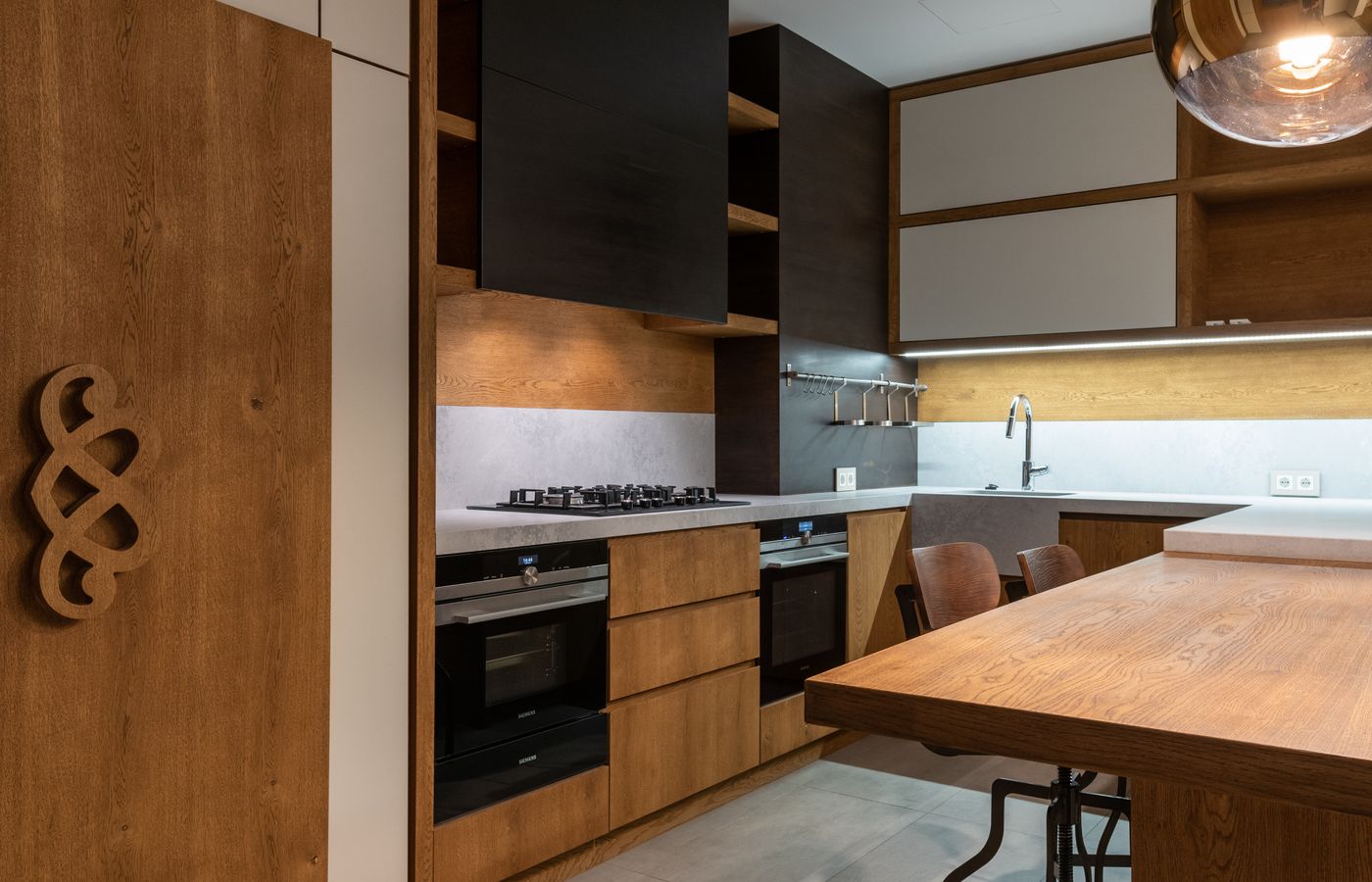
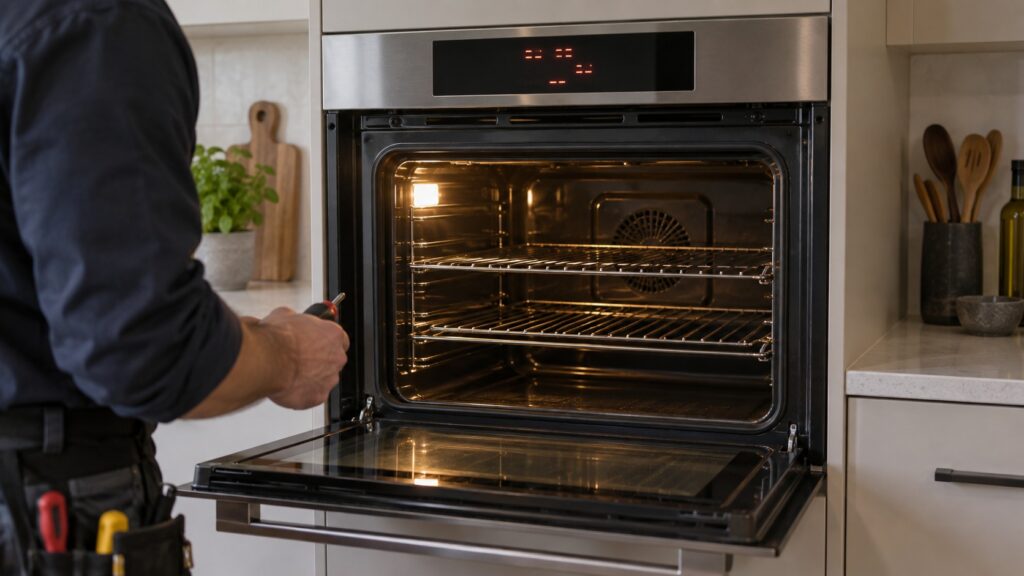
F3 E0 on an Amana wall oven is an open oven sensor. The control sends a small current through the temperature probe in the cavity and measures what comes back; when the circuit reads as broken, it stops and prints the code. The Amana oven F3 error code is therefore one of the few codes that names a single, replaceable, testable part — and that is good news, because it is one of the cheaper repairs on the appliance.
What is the oven sensor and why does everything stop without it?
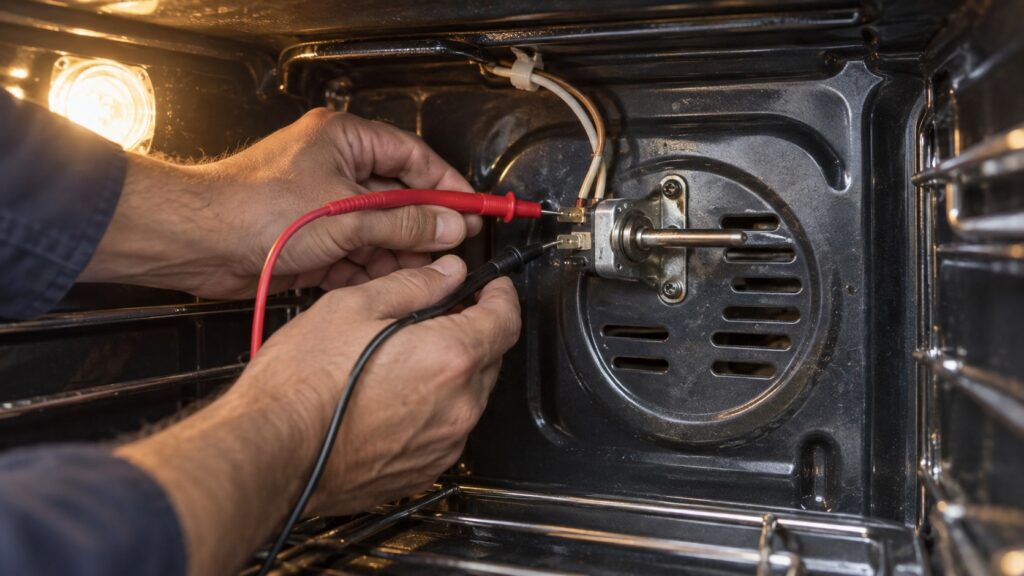
The probe you can see poking through the upper left or upper rear of the oven cavity is a resistance temperature detector. Its resistance rises predictably with heat, and the control converts that resistance into degrees. There is no thermostat in the old mechanical sense on these appliances: this probe is the only thing that knows how hot the oven is.
That is why an open sensor is a full stop rather than a degraded mode. Without a reading, the control has two options — run the element blind, or refuse. It refuses, and the safety logic behind that refusal is the reason you should never see this code as an invitation to work around it.
Is the Amana oven F3 error code the same on a range?
The fault is the same; the way it is spelled depends on the control generation. Our code pages give a bare F3 on an older Amana range as an open oven temperature sensor, explicitly an RTD. F3 E0 on a newer control, whether in a wall oven or a range, says open oven sensor in the paired format.
There is also an F3 E1 in the modern family, and the pairing is not decoration: the second group distinguishes how the sensor circuit failed, not which sensor it is. If you want the whole map of which Amana code shapes belong to which control generation, our guide to Amana error code families lays them out together.
Why does an open sensor fail more often than a shorted one?
Because of what actually breaks. The sensor element itself is robust. What fails is almost always a connection: the crimped joint where the probe’s leads meet the oven harness, the two-pin plug behind the rear panel, or the insulation on the leads where they pass through the cavity wall.
That connection lives in the hottest, dirtiest part of the appliance and it goes through a full heating and cooling cycle every time you bake. Metal expands, contracts, oxidizes, and eventually a crimp that was tight in year one is loose in year twelve. A loose connection reads as open, not as short, which is why open is by far the more common of the two faults.
It also explains the most frustrating version of this code: an oven that works perfectly cold and throws F3 E0 twenty minutes into a bake. The connection is intact until thermal expansion pulls it apart, then closes again as the oven cools. A technician chasing that one tests warm, not cold.
Where does the sensor sit, and what damages it?
On most Amana wall ovens and ranges the probe enters through the upper rear or upper left of the cavity and is held by a two-screw bracket. The leads run through a grommet to a plug behind the rear panel. Replacing it is a short job on a range and a longer one on a built-in wall oven, purely because the appliance has to come out of the cabinet.
Three things shorten a sensor’s life. Self-clean cycles run the cavity far above cooking temperature and are the hardest single hour a sensor ever has; ovens that are cleaned that way monthly lose sensors sooner. Racks pushed in hard against the probe bend the stem and stress the bracket. And aggressive cleaning around the probe, particularly anything sprayed directly at it, gets into the grommet and attacks the lead insulation.
If your oven is not heating at all and shows no code whatsoever, the sensor is not the first suspect — start from our guide to an Amana wall oven that is not heating, which separates element, ignition and control faults.
Can I bake while F3 E0 is showing?
No, and on most Amana controls you will not be allowed to. The oven will refuse the cycle or drop out of it. If yours does somehow start and you can hear or see the element glowing while the code is present, switch the appliance off at the breaker and leave it off until it is looked at.
The cooktop on a range is on a separate circuit from the oven control on most layouts, so it generally keeps working, and that is fine to use. What is not fine is any attempt to bridge the sensor circuit, fit a substitute probe of a different type, or run the oven on a timer to “get through the weekend.” The sensor is the only temperature limit the appliance has during normal baking.
Is it the sensor or the wiring behind it?
Both possibilities are live, and the test is the same: measure the resistance at the control end of the harness, then at the probe itself, and compare both against the values on the tech sheet that ships inside the appliance. If the probe measures correctly and the harness does not, the fault is in between, and swapping the sensor would have fixed nothing.
That is worth saying because the sensor is the part everybody buys first. It is inexpensive, it is easy to find, and roughly a third of the time it is not the problem. When the appliance is a built-in wall oven the arithmetic tips further, since the labor of pulling the unit out dwarfs the part — which is the same calculation behind our wall oven repair or replace guide.
When should you call?
Call as soon as F3 E0 persists through a five-minute power cut at the breaker, or as soon as it appears part way through bakes. Have the model and serial number from the tag on the oven door frame ready, because sensor and harness part numbers split by model and production year even when the probes look identical.
We are an independent repair company, not a factory service arm. Pricing starts from a diagnostic visit and we confirm the estimate before any work begins. Call 1-844-760-0459, read what Amana oven repair covers, or schedule a visit online.