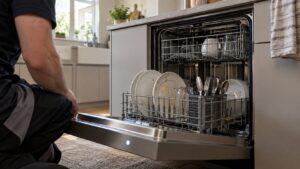
Getting amana dishwasher installation right prevents the drain and leak problems that otherwise show up on the very first cycle — especially the disposer knockout plug and the drain loop.
Amana ADB dishwashers report a full F#E# code set; on models without a digital display the same code is flashed through the Clean light (an F-count, a pause, then an E-count), so there is no separate blink dictionary — read the F#E# the same way either way, and write the digits F-then-E. We start with the everyday causes you can check yourself, then explain the signs that point to a part that genuinely needs a hands-on repair.
What a amana dishwasher installation usually means
An ADB dishwasher needs a hot-water supply, a power connection, and a drain routed with a high loop or through an air gap so dirty sink water cannot siphon back. The most common install mistakes are leaving the disposer knockout plug in place (so it cannot drain) and a low drain run. A level cabinet keeps the door and overfill float reading correctly.
First checks you can do
Start with the checks you can safely do yourself. Each one rules out a common, inexpensive cause, and together they resolve the majority of cases without a service visit:
- Connect the hot-water supply and confirm the shutoff is accessible.
- Remove the disposer knockout plug if draining through a disposer — a common miss that blocks draining.
- Route the drain hose in a high loop or through an air gap to prevent backflow.
- Level the cabinet, then run a cycle and check every connection for leaks.
Take these in order and confirm whether the problem has cleared before moving to the next. If you do end up needing help, having worked through them gives the technician a useful head start.
Getting it right for the long run
After the unit is connected, run a short first cycle and watch it closely. Confirm there are no leaks at any connection, check that the appliance is steady and level, and make sure no error code or status word appears on the display. Catching a loose fitting or an overlooked step now, while everything is still accessible, is far easier than diagnosing it later. A few minutes of observation at the end of the install saves a service call down the line.
It is worth photographing each connection and the model and serial label before you close everything up, because that small record makes any future service call faster. Take the extra minute to confirm clearances, the supply type, and a clean first cycle now, while the unit is still accessible — the most common first-week Amana dishwasher complaints trace straight back to a step skipped during installation rather than to a defective appliance, so a careful setup is the cheapest reliability you will ever buy.
Putting it together
Work the checks above in the order given. Most Amana dishwasher problems of this kind clear at one of the early, owner-checkable steps; the ones that do not point to a specific part and are worth a proper diagnosis rather than guesswork. Move from the simplest cause outward, confirm each step before the next, and treat a returning code or a lingering symptom as your cue to bring in help. A little routine care afterward prevents most repeat calls, since Amana builds these dishwashers to be dependable and easy to live with.
Related reading: Amana dishwasher won’t drain, Amana dishwasher maintenance, and our dishwasher repair service.
Book Amana dishwasher service
If these steps do not resolve it, our experienced, independent technicians repair Amana dishwashers with genuine OEM parts and a 30-day labor warranty. Schedule a visit, see what our dishwasher repair service covers, or confirm your model details on the manufacturer’s site at amana.com.