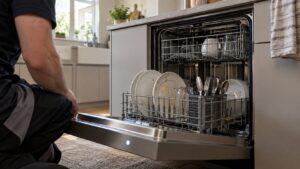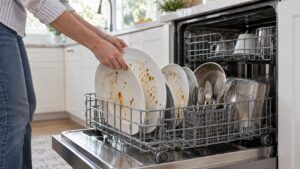
An amana dishwasher not cleaning dishes well is usually about water reaching the soil, not a failed motor — clogged spray arms, a dirty filter, cool water, or scale are the common causes.
Amana ADB dishwashers report a full F#E# code set; on models without a digital display the same code is flashed through the Clean light (an F-count, a pause, then an E-count), so there is no separate blink dictionary — read the F#E# the same way either way, and write the digits F-then-E. We start with the everyday causes you can check yourself, then explain the signs that point to a part that genuinely needs a hands-on repair.
What a amana dishwasher not cleaning usually means
Clean dishes need hot water sprayed forcefully through the spray arms and a clear Triple Filter Wash System trapping the soil. Clogged spray-arm jets, a filter packed with food, water that never reaches temperature, hard-water scale, or dishes that block the spray pattern all leave grit behind. The spray path and the filter are checked before any part is suspected.
First checks you can do
Start with the checks you can safely do yourself. Each one rules out a common, inexpensive cause, and together they resolve the majority of cases without a service visit:
- Remove and rinse the Triple Filter Wash System and clear the spray-arm holes of debris.
- Run the kitchen tap hot before starting so the dishwasher fills with hot water.
- Use fresh detergent and rinse aid, and confirm the dispenser opens during the cycle.
- Load so tall items do not block the spray arms from turning.
Take these in order and confirm whether the problem has cleared before moving to the next. If you do end up needing help, having worked through them gives the technician a useful head start.
When it is a problem, not a habit
If the everyday checks above do not resolve it, the problem has likely moved from something you can adjust to a component that needs testing or replacing. These are the signs that point that way:
- Spray arms and filter are clean but cleaning is still poor — a failed wash motor (F7E1).
- Water never gets hot — a heater or thermistor failure (F3E1 / F2 heater).
- White film on everything — hard-water scale needing a descale and rinse aid.
At this point a proper diagnosis beats guesswork, since the remaining causes involve a specific part or electrical testing. An experienced technician can meter the suspect component and fit a genuine OEM part so the repair lasts.
Getting it right for the long run
If the basics here do not clear it, resist the urge to start swapping parts at random. The remaining causes usually involve a specific component that needs testing, and a confident diagnosis is what keeps the repair affordable and the appliance reliable afterward. A skilled technician can confirm the cause, fit a genuine OEM part, and stand behind the labor, which is a better outcome than guesswork. Knowing where the line falls between an easy self-fix and a real repair is the most useful thing to take from this guide.
Putting it together
Work the checks above in the order given. Most Amana dishwasher problems of this kind clear at one of the early, owner-checkable steps; the ones that do not point to a specific part and are worth a proper diagnosis rather than guesswork. Move from the simplest cause outward, confirm each step before the next, and treat a returning code or a lingering symptom as your cue to bring in help. A little routine care afterward prevents most repeat calls, since Amana builds these dishwashers to be dependable and easy to live with.
Related reading: Amana dishwasher not drying, Amana dishwasher maintenance, and our dishwasher repair service.
Book Amana dishwasher service
If these steps do not resolve it, our experienced, independent technicians repair Amana dishwashers with genuine OEM parts and a 30-day labor warranty. Schedule a visit, see what our dishwasher repair service covers, or confirm your model details on the manufacturer’s site at amana.com.