Amana dryers series and lineup
Amana dryers are the brand’s value-built laundry, sold in two fuel types that get repaired differently. Electric (NED) models such as the NED4655EW and NED5800HW use a heating element on a 240V supply, while gas (NGD) models such as the NGD4655EW and NGD5800HW use an igniter and gas valve, with older builds like the NGD5240TQ serviced as repair-lookup work. A key service distinction is that electronic-display models show genuine codes, while the many budget timer-controlled models — the bulk of the affordable line — signal by symptom only, with no code at all. Note that trailing-digit forms of a model number are parts revisions, not separate retail models, so the base model is confirmed first. You can review the current dryer range on the manufacturer’s site at amana.com and the models we service in our model directory, while step-by-step help is gathered in our repair guides.
Technologies and features
Amana dryers keep drying simple and gentle. Automatic Dryness Control and the AutoDry System read the load with a moisture sensor so the cycle stops when the clothes are dry rather than running on a fixed timer, the Wrinkle Prevent Option tumbles intermittently after the cycle to keep clothes from creasing, Tumble Press® helps release wrinkles, and the SofSound™ Quiet Package keeps the dryer running quietly. Because the design is practical rather than gadget-laden, the parts that wear are, on an electric NED, the heating element, the thermal fuse, and the high-limit and cycling thermostats; on a gas NGD, the igniter, the gas valve coils, and the flame sensor; and on both, the drive belt, the idler pulley, the drum rollers, the exhaust thermistor and moisture sensor, and the control board — all matched to the specific NED or NGD build. The electric and gas versions of the same model share the cabinet, drum, belt, and rollers but differ entirely in how they make heat, which is the first thing a technician confirms on a no-heat call: an electric dryer needs its 240V supply and element checked, while a gas dryer almost always comes down to the igniter, the most common no-heat cause on the gas line. Knowing whether the unit is an electronic-display model or a budget mechanical-timer model is the other key distinction, since one shows a code and the other must be read entirely by symptom.
Common issues and maintenance
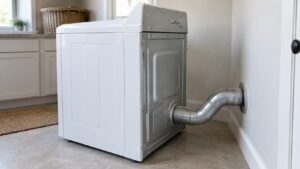
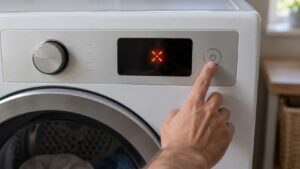
Amana dryers are diagnosed two ways. Electronic-display models report letter codes — PF (power failure), AF (restricted airflow), and L2 (low or no line voltage) — plus the F#E# scheme: F2E1 (stuck key), F2E2 (UI disconnected), F3E1 (exhaust thermistor), F3E2 (moisture sensor), and F4E3 (restricted airflow, the same as AF). Older numeric boards instead show F## codes such as F22/F23 (exhaust thermistor) and F30 (restricted airflow). The many mechanical-timer models have no code at all and are read by symptom: no heat, will not start, will not tumble, takes too long, overheats, noise, or a burning smell. The single most common cause of a no-heat or takes-too-long complaint is a restricted vent, not a failed part — an AF or F4E3 code says exactly that, and even where no code shows, a clogged duct is the usual culprit. So routine care matters more on a dryer than almost any appliance: clean the lint screen every load, vacuum the full exhaust duct at least yearly, keep the run as short and straight as possible, and check the vent flap opens freely outside. A restricted vent not only slows drying but overheats the cabinet and is a genuine fire risk, so it is always cleared before any part is condemned. On a gas model the igniter is the most common no-heat cause, while a drum that will not turn usually points to a worn belt or idler pulley rather than the motor. Note that dET or Et are washer codes, not dryer codes. For meanings and next steps, see our Amana dryer error codes and our repair guides.
When to call for repair
Heating elements, gas igniters and valve coils, thermostats, thermal fuses, belts and rollers, moisture sensors, and control boards are best handled by experienced technicians who can read the code or symptom and, on so many no-heat and takes-too-long calls, clear the airflow path before condemning a part. As an independent, third-party service our skilled technicians fit genuine OEM parts from trusted parts suppliers and back every visit with a 30-day labor warranty on the workmanship. A burning smell means the dryer should be taken out of service until the lint and worn parts are found. Note the fuel type, whether the model is electronic or timer-controlled, and the exact NED or NGD model number when you book. A clear quote is given before work begins and the total depends on the diagnosis — pricing starts from a trip-and-diagnostic fee, and we never quote a fixed repair price sight unseen. Schedule Amana dryer repair or book an appointment online.