Knowing how to level an amana washer is the difference between a quiet spin and a machine that shakes and walks — and it takes only a few minutes at install or after a move.
Amana NTW top-load and NFW front-load washers report F#E# codes plus lettered aliases such as Sd for suds, LF for long fill, Ld for long drain, and uL for unbalanced; the official mapping is F0E2 suds, F0E3 overload, and F0E5 off-balance, and LOC or LC is the control lock, a feature rather than a problem. We start with the everyday causes you can check yourself, then explain the signs that point to a part that genuinely needs a hands-on repair.
What a level an amana washer usually means
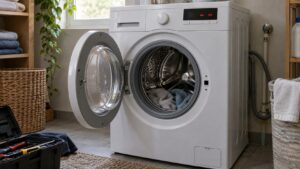
A washer reaches high spin speeds, so it must sit dead level on a firm floor with no rock. Uneven feet or a soft floor let it rock and walk, and on a front-load NFW the transit shipping bolts must come out first or it will shake violently. Getting all four feet firmly down and the cabinet level prevents the most common vibration complaint.
First checks you can do
Start with the checks you can safely do yourself. Each one rules out a common, inexpensive cause, and together they resolve the majority of cases without a service visit:
- On a front-load NFW, remove the shipping bolts before anything else.
- Set the washer on a firm, flat floor and rock each corner to find the high foot.
- Adjust the feet so the cabinet sits firm with no rock in any direction.
- Check with a level front-to-back and side-to-side, then tighten any jam nuts.
Take these in order and confirm whether the problem has cleared before moving to the next. If you do end up needing help, having worked through them gives the technician a useful head start.
Getting it right for the long run
After the unit is connected, run a short first cycle and watch it closely. Confirm there are no leaks at any connection, check that the appliance is steady and level, and make sure no error code or status word appears on the display. Catching a loose fitting or an overlooked step now, while everything is still accessible, is far easier than diagnosing it later. A few minutes of observation at the end of the install saves a service call down the line.
It is worth photographing each connection and the model and serial label before you close everything up, because that small record makes any future service call faster. Take the extra minute to confirm clearances, the supply type, and a clean first cycle now, while the unit is still accessible — the most common first-week Amana washer complaints trace straight back to a step skipped during installation rather than to a defective appliance, so a careful setup is the cheapest reliability you will ever buy.
Putting it together
Work the checks above in the order given. Most Amana washer problems of this kind clear at one of the early, owner-checkable steps; the ones that do not point to a specific part and are worth a proper diagnosis rather than guesswork. Move from the simplest cause outward, confirm each step before the next, and treat a returning code or a lingering symptom as your cue to bring in help. A little routine care afterward prevents most repeat calls, since Amana builds these washers to be dependable and easy to live with.
Related reading: Amana washer shaking and walking, Amana washer maintenance checklist, and our washer repair service.
Book Amana washer service
If these steps do not resolve it, our experienced, independent technicians repair Amana washers with genuine OEM parts and a 30-day labor warranty. Schedule a visit, see what our washer repair service covers, or confirm your model details on the manufacturer’s site at amana.com.