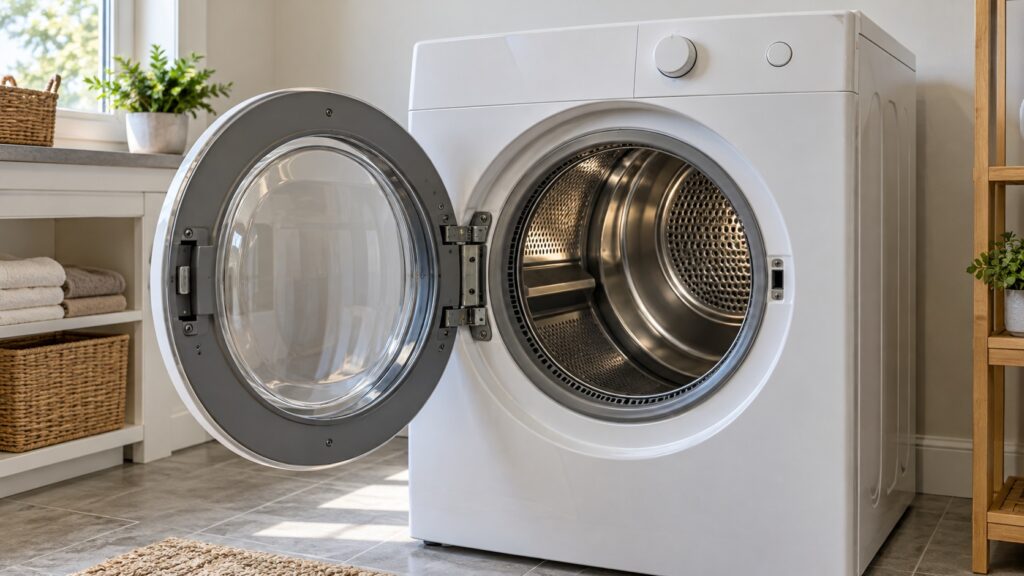
When an Amana gas dryer stops heating or starts misbehaving, the question is whether to repair it or buy a new one. People search for “amana gas dryer replace” and “amana gas dryer repair” at this point, and the honest answer is the same as for any dryer: it depends on what failed, how old the dryer is and what else is wearing out. Our Amana pages say that a gas NGD dryer that does not heat most often needs a new igniter, then the gas valve coils or the flame sensor, and that a clogged vent can also kill the heat. This guide explains how to think about the decision, what an owner can safely do and why anything involving gas belongs to a professional, both when repairing and when replacing. We give no prices or lifespans.
What goes wrong on an Amana gas dryer?
A gas dryer has everything an electric one has, a drum, a belt, rollers, a motor, thermostats and a vent, but it heats the air with a gas burner and not an electric element. The burner needs an igniter to start it, a gas valve to let gas through and a flame sensor to confirm the flame. Our dryer not heating guide lists those for the gas NGD models: the igniter is the single most common cause, followed by the gas valve coils and the flame sensor. It also lists a clogged vent as a reason for lost heat, because overheating can trip a safety part.
The parts that fail on a gas dryer are mostly the ordinary ones: belts, rollers, a thermal fuse, thermostats and the igniter. Our Amana dryer repair or replace guide says repair almost always wins when the problem is a belt, igniter, thermal fuse, thermostat or roller set, and that replacement is worth considering when the drive motor or control board fails on an older unit.
What can you check yourself, safely?
Stay with the airflow. Clean the lint screen, check that the hose behind the dryer is not crushed and that the outdoor flap opens, and clear the vent as our vent cleaning guide explains. Check that the dryer is not on a no-heat or air fluff setting. Check the breaker for the dryer’s power, since even a gas dryer needs power for the controls and the drum. Our dryer not heating guide lists the checks in order.
Do not go beyond that. Do not open the cabinet, the burner area or the back panel, do not touch the gas line or the shutoff and do not try to light or test the burner. If you smell gas at any time, do not switch anything on or off, do not light anything, leave the house and call the gas company or 911 from outside.
When does repairing make sense?
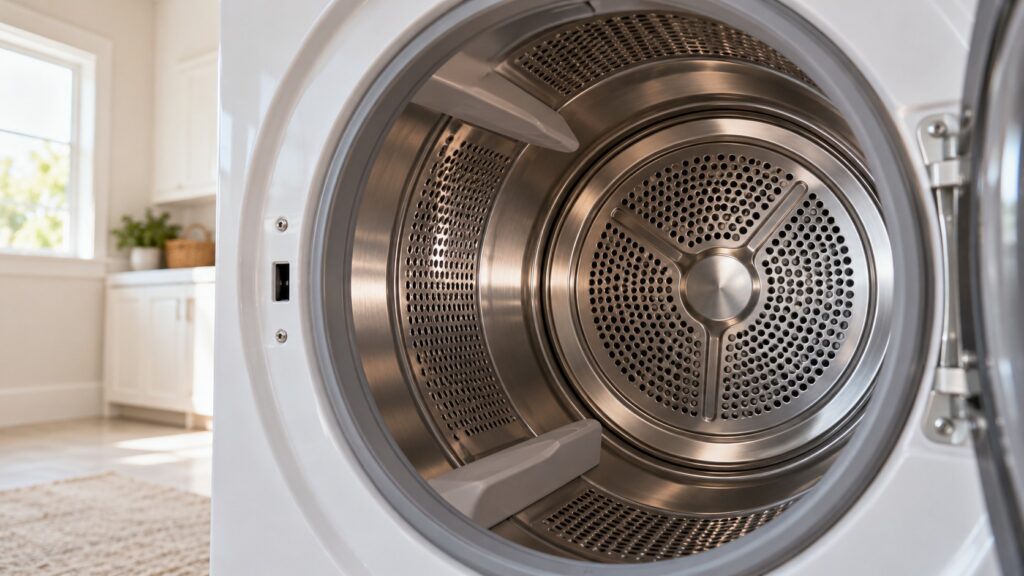
Repair tends to make sense when the dryer is not old, the fault is one common part and the rest of the dryer is sound. A new igniter on a dryer that otherwise dries well is the classic example. It also makes sense when the vent was the real cause and the dryer has been overheating, since clearing the vent and replacing a safety part is a modest job. Ask the technician to explain what failed, what they will replace and what the total will be, in writing, before any work starts.
Consider the dryer’s history as well. A dryer that has been trouble-free for years and then needs one part is a better candidate than one that has already needed several repairs. Our dryer repair cost guide covers typical repair costs, and our dryer repair or replace guide gives the framework in more detail.
When does replacing make sense?
Replacement starts to look better when the dryer is old and also needs a major part, when it has had repeated repairs, when parts are hard to find or when the repair cost is close to the price of a comparable new dryer. If you replace, the new dryer needs the same things as the old one: a vent that is short, straight and clear, a 120-volt outlet for the controls of a gas model and a safe gas connection. Our electric versus gas dryer guide compares the hookups, and our NED and NGD buying guide covers a matching pair of models.
The gas connection on a new dryer is not an owner job. Have a professional make or check it, and ask them to test it for leaks. Leave the choice of connector to the installer, and do not reuse an old one on your own. Our dryer installation guide covers the vent and electrical points.
When should you call a technician?
Call as soon as the dryer shows no heat after you have cleared the vent, runs hot, smells of gas or burning, or has more than one fault. If you smell burning or see smoke or sparks, switch off the breaker at the panel while standing on a dry floor and keep the area clear. A technician can diagnose the dryer, tell you honestly whether repair is sensible and give you an estimate. We are an independent repair company. Read about our Amana dryer repair or schedule a visit.