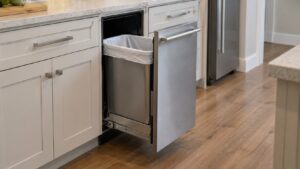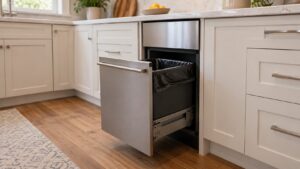
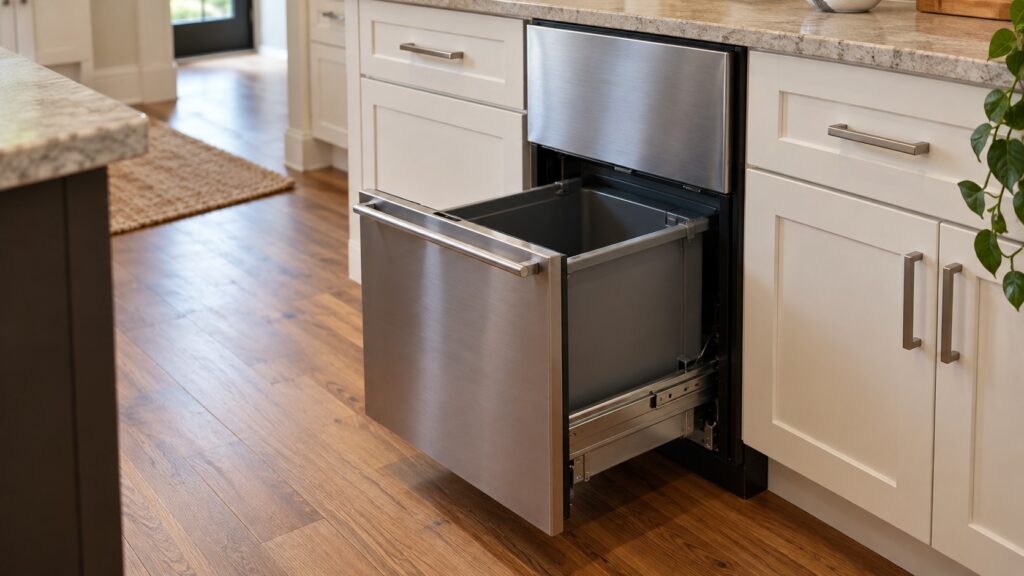
Amana EasyAccess refers to the front-opening drawer design used on Amana trash compactors, built so you load and empty the compacted bag from the front of the unit rather than lifting a top-loading lid — it means everyday use and bag removal both happen without needing clearance above the unit or bending over an open top.
What does Amana EasyAccess actually change about using a trash compactor?
A front-opening drawer pulls out toward you like a large drawer, rather than lifting up and away like a lid, which matters most on a built-in compactor installed under a counter where there is no room to swing a lid upward. Loading trash, and later pulling out the compacted bag for disposal, both happen through the same front opening, so you never need to reach up and over the unit the way a top-loading design requires.
Why does this front-loading design matter more for built-in installations?
A freestanding trash compactor with a top lid has open space above it to lift the lid fully; a built-in unit tucked under a counter or between cabinets typically does not have that clearance, since a counter or cabinet sits directly above it. A front-opening design solves that constraint entirely by not needing any lid to lift in the first place, which is exactly why this layout shows up specifically on compactors meant for built-in installation rather than on freestanding units where a top lid works just fine.
Does front-loading change how the actual compaction mechanism works?
No — the ram that compresses trash inside the bag operates the same way regardless of whether you load the unit from the front or the top; this is a loading-and-access design, not a change to the compaction mechanism itself. If your compactor is having trouble actually compacting waste, that points at the ram motor or its drive system rather than anything related to the front-opening drawer, covered in our guide on an Amana trash compactor that won’t compact.
What tends to wear out first on a front-opening design?
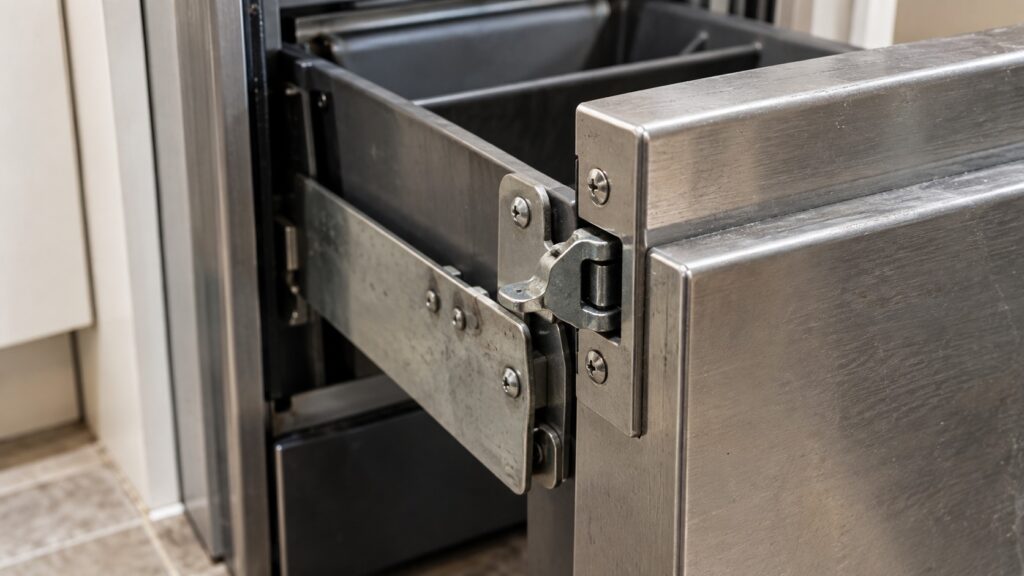
The drawer’s latch and hinge mechanism take the most repeated physical use on this design, since every load and every bag removal cycles that latch open and closed, day after day for years. A latch that no longer catches securely, or a drawer that feels loose when pulled open, is worth having checked before it worsens — a compactor that won’t close properly cannot safely run its compaction cycle, which is covered in our guide on an Amana trash compactor that won’t close.
How should you clean a front-opening trash compactor drawer?
Wipe down the interior drawer surfaces and the front panel regularly, since compacted trash occasionally leaks liquid or odor that a top-loading design would not expose in quite the same way at the front opening. A mild household cleaner and a damp cloth are sufficient for the drawer surfaces; avoid spraying cleaner directly into the latch mechanism itself, since that can wash lubricant out of the hinge and accelerate the wear described above rather than prevent it.
Is a compactor with this feature worth choosing over a top-loading model?
If your kitchen layout is a built-in installation with a counter or cabinet above the unit, a front-opening design is close to a requirement rather than a preference, since a top-loading lid simply will not have room to open. For a freestanding unit with open space above it, the choice comes down to personal preference for the loading motion — some people find lifting a lid from above easier on the back, while others prefer pulling a drawer straight out. Neither affects the compactor’s actual compaction performance.
What should you do if the drawer sticks or feels harder to open than it used to?
A drawer that has become stiff to pull, without any visible damage to the latch, often just needs the slide track cleaned of accumulated debris and lightly lubricated per the manufacturer’s guidance — trash compactors accumulate more grime around their moving parts than most kitchen appliances given what passes through them daily. If cleaning and light lubrication do not restore smooth movement, the drawer’s slide hardware itself may have worn out and is worth having assessed rather than continuing to force an increasingly stiff drawer.
Does the front-opening design affect how much trash the compactor can hold?
Not directly — capacity is set by the size of the compaction chamber and how far the ram travels, not by which side of the unit you load from. A front-opening drawer and a top-loading lid on otherwise similar Amana compactor models hold roughly comparable volumes of compacted waste, so choosing between the two designs is genuinely a matter of installation constraints and loading preference rather than a capacity trade-off. If you are comparing two specific models and capacity is the deciding factor, check each model’s own compaction ratio and bag size rather than assuming the loading style tells you anything about how much trash it holds.
What liner size should you use with an EasyAccess drawer?
Using the bag size Amana specifies for your exact model matters more with a front-opening drawer than it might seem, since a liner that’s too large bunches up around the drawer’s edges and can catch on the latch mechanism when you pull the drawer open, while a liner that’s too small leaves gaps that let compacted debris shift and press directly against the drawer walls. Neither mistake damages the compactor immediately, but both make the drawer harder to open smoothly over time and add unnecessary wear to the same latch and slide hardware that already sees the most repeated use on this design.
We are an independent repair company, not a factory service arm, and we will tell you when a repair is not worth doing. Pricing starts from a diagnostic visit and we confirm the estimate before any work begins. If your trash compactor’s drawer or latch isn’t working the way it should, our Amana trash compactor repair service can take a look — you can schedule a visit online.