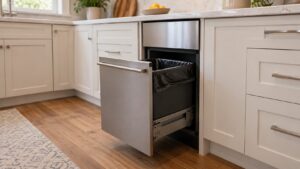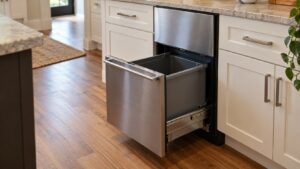
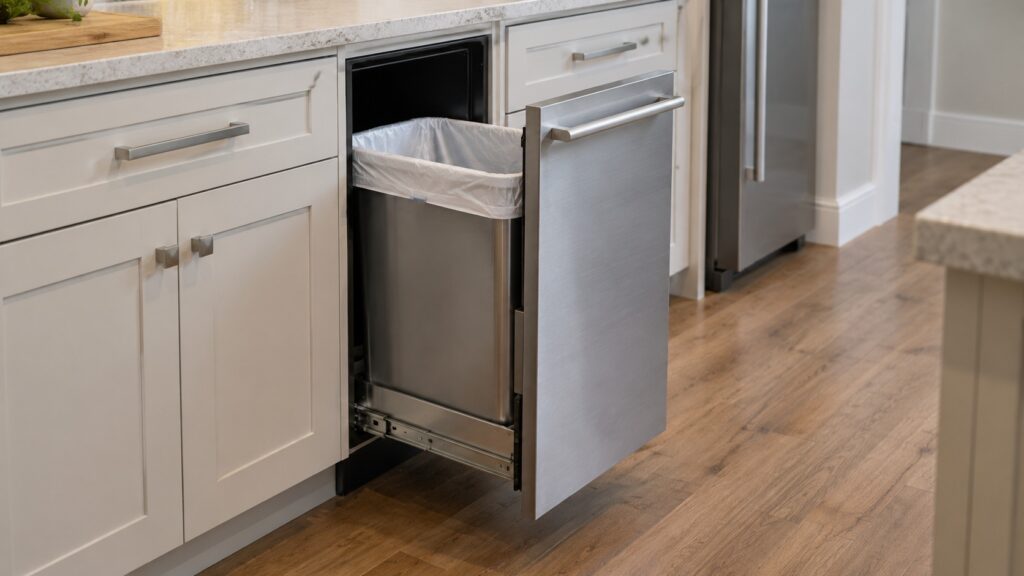
An Amana trash compactor is a simple machine: a motor turns a drive train that pulls a heavy metal ram down into the bin, squeezes the trash and then lifts the ram back to the top. There is no circuit board and no display. The Amana SMC-1 and SMCD-2 are electromechanical, with a motor, drive nuts, a ram and a handful of switches, so every fault comes from a part you can name. This guide explains how an Amana trash compactor works, what each part does and which symptom points at which part, which is the fastest way to understand a unit that will not start, will not compact or will not come back up.
What are the main parts of an Amana trash compactor?
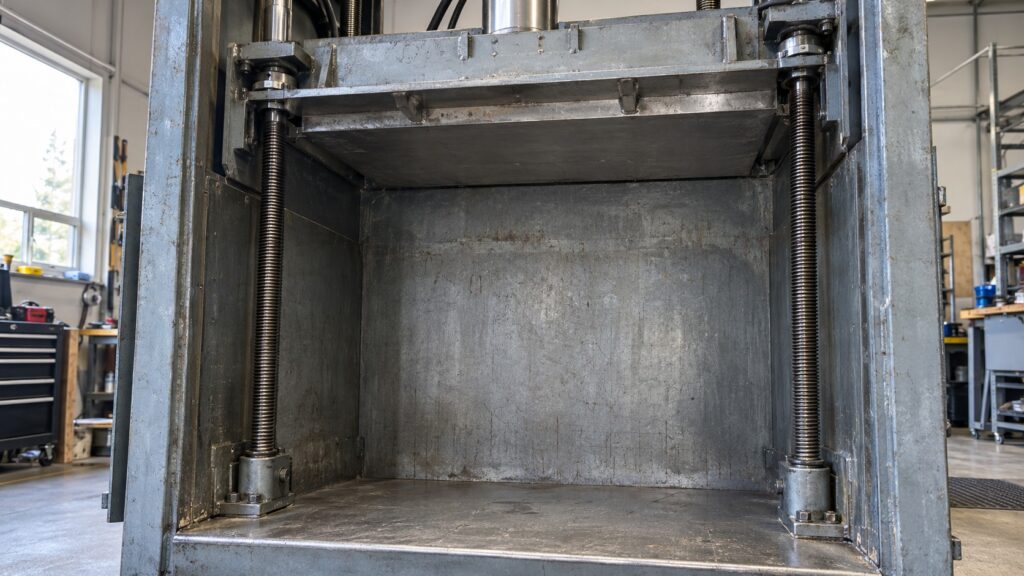
There are five parts that do the work. The motor provides the turning force. A drive train, made of a gear, a chain and a sprocket, carries that force to two long threaded screws on either side of the bin. A pair of power nuts rides on those screws and is fastened to the ram, so when the screws turn, the nuts and the ram travel down or up. The ram is the heavy plate that squeezes the trash. The switches decide when the motor runs and which way the ram moves.
Around that sit the drawer, which holds the bag and slides out for loading, and a safety interlock switch that prevents the motor from running unless the drawer is closed.
What happens during a compacting cycle?
You close the drawer, which makes the interlock switch, and turn the control on, which closes the start switch. The motor runs, the drive train turns the screws and the power nuts pull the ram down. The ram presses the trash until the load resists enough that the cycle reverses, or until the ram reaches the bottom of its travel. A directional switch then reverses the motor, and the ram rises. At the top, a top-limit switch opens and stops the motor, leaving the ram parked clear of the bag.
A thermal overload protects the motor. If the motor strains against a jam or an overloaded bin, the protector opens, the compactor stops mid-cycle and it will not run again until the motor cools. Behind that sits a thermal fuse, which opens permanently if the overload protection fails to act in time.
How does each part fail, and what does it look like?
The mapping from symptom to part is why the machine is easy to diagnose without codes.
Our guides to a compactor that will not start, one that will not compact and one that will not close or stops mid-cycle take each symptom step by step.
Why is a jam more serious than it looks?
The ram applies a lot of force, and anything that does not compress can stall the drive. Glass, metal cans stacked on end, a bottle that lands upright and bulky cardboard can all wedge the ram. The motor works harder, the overload trips and, if the jam repeats, the gear, the chain or the power nuts wear out. Load the bin sensibly, break down boxes and keep rigid items flat. Never reach under the ram, and never try to free a jammed ram with your hand while the compactor is plugged in. Unplug it first, and when the ram is stuck low, let a technician free it, since the stored force in the drive can move it unexpectedly.
What do the model names tell you?
The two Amana compactor models on this site, the SMC-1 and the SMCD-2, are both listed as discontinued and parts-only, and both are built as built-in or freestanding units with a front drawer. The mechanism is the same on each: electromechanical, with the motor, drive nuts and ram described above. If you have a different brand of compactor, the parts are similar but the layout differs, so match the symptom to the part list before ordering anything.
How do you look after the parts?
Keep the drawer track clean and straight, clear debris from the path of the drawer, and replace the bag as soon as it is full, since an overloaded bag is a common cause of strain. Wipe the bin to prevent odors, and check that the drawer closes and the interlock makes with a clear click. Our Amana trash compactor maintenance guide lists the routine checks.
Is it worth repairing a legacy compactor?
Amana no longer makes a current compactor, so parts for the SMC-1 and SMCD-2 are limited to what is still available. A switch, a fuse or a drawer repair is usually modest, while a worn drive train or a damaged ram is a bigger job on a unit that may be decades old. Our Amana trash compactor repair or replace guide sets out the decision. We are an independent repair company, not the manufacturer, and we will tell you plainly if a repair is not worth doing. Our Amana trash compactor repair service can diagnose it, and you can book a visit online.