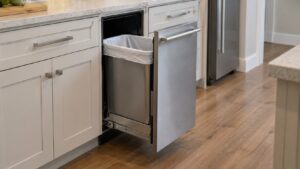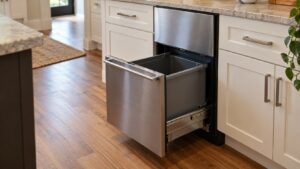
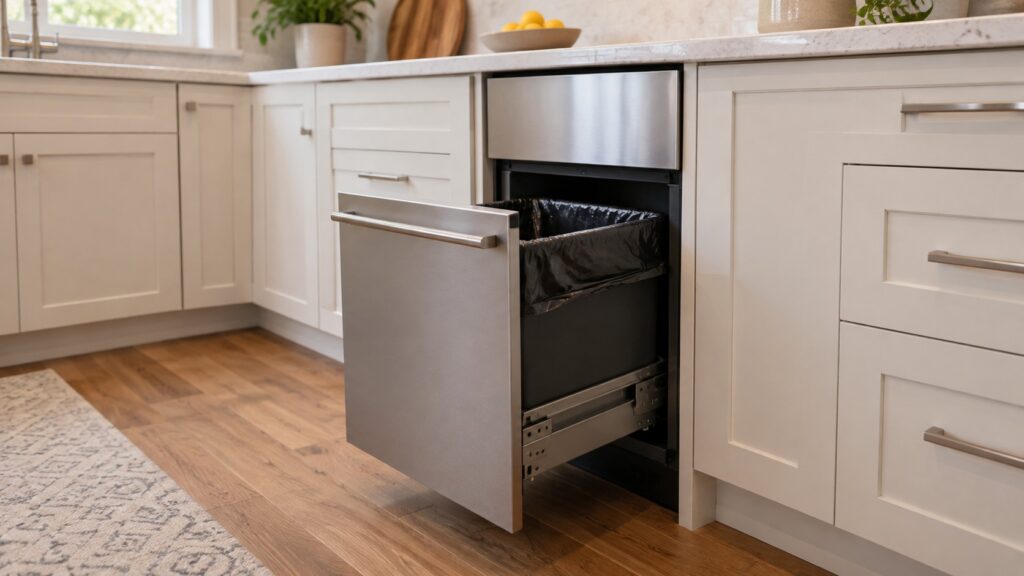
Amana trash compactor maintenance is mostly cleaning and caution. Unplug the compactor before you work on it, empty it before it gets overfull, wipe the drawer, bag ring and tracks, keep the area around the ram clear of debris, and never put glass, liquids or aerosols in it. Amana no longer makes a current compactor; the SMCD-2 and SMC-1 are discontinued, parts-only units that we still service. They are purely electromechanical, with a motor, drive nuts and a ram, and are controlled by switches rather than electronics, so there are no error codes. That makes maintenance straightforward.
How does an Amana trash compactor work, in brief?
When you close the drawer and turn the compactor on, the drawer interlock switch confirms it is shut. A motor then turns a drive that moves a ram downward through two drive nuts, pressing the trash into the bag and drawer. Switches tell the compactor when the ram has reached the bottom and when it has returned to the top, and when it has finished, the ram goes back up and stops. Because it is purely mechanical and electrical, with no circuit board, a problem is almost always one of a small number of causes: the interlock, a limit switch, the motor or something that is jamming the ram. Knowing that helps you understand why most maintenance is about keeping things clean and clear.
How often should you clean it?
Empty the compactor when the bag is full, and do not leave a full bag sitting for days, because food waste smells and attracts pests. Once a month, or sooner if something spills, unplug the compactor, remove the bag and wipe the drawer, the bag ring, the front panel and the ram surface with a damp cloth and mild soap, then dry everything. Wipe the drawer tracks and rollers to remove grit that can make the drawer stick. Avoid spraying cleaner into the machine, since liquid can reach the switches and motor. For odor, a deodorizer made for compactors helps, though emptying on time helps more. If compaction itself seems weak, our Amana trash compactor will not compact guide lists what to look at.
How do you change the bag properly?
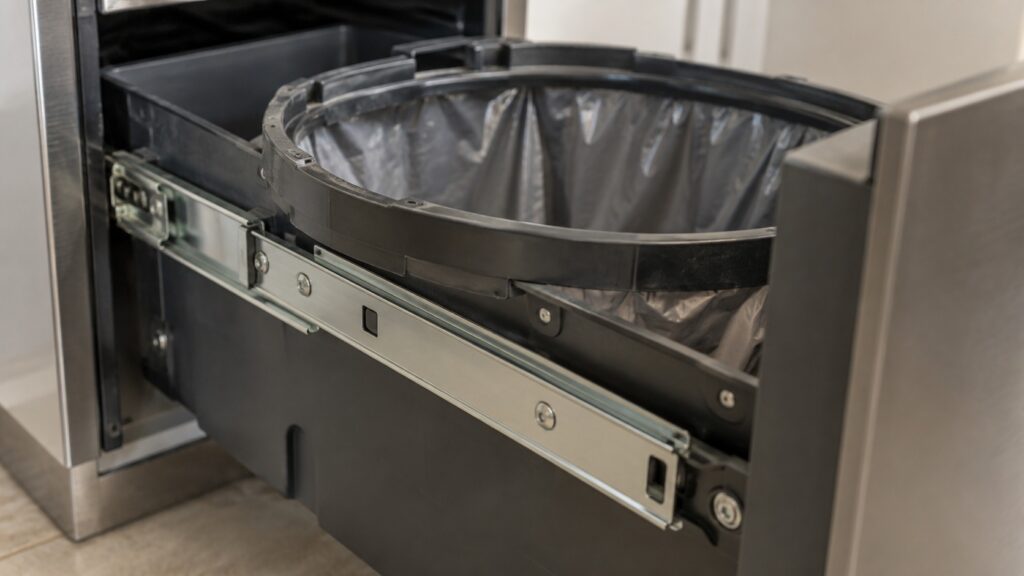
Switch the compactor off at the outlet or unplug it, then open the drawer fully. Lift the filled bag out by its top, folding the edges inward so nothing spills, and seal it. Wipe the inside of the drawer if anything leaked. Fit a new bag so it sits inside the drawer and the top edge is held by the bag ring or clips, with the bag fully open and no folds hanging where the ram will come down. A bag that is not seated can be dragged by the ram and cause a jam. Close the drawer, plug in and test with a small amount of light trash before loading it fully.
Keep a note of the right bag size for your model, and do not double-stack bags or use ordinary kitchen bags that are too thin, since they tear under pressure.
What should never go in the compactor?
Glass, because it shatters into sharp fragments that can pierce the bag and jam the ram. Liquids, because they leak, run into the mechanism and create odors. Aerosol cans, paint and anything pressurized or flammable, because compacting them can start a fire or burst. Hot ashes or cigarettes. Large, hard objects like bones, which can stall the ram. Tie or fold liquids and wet food into sealed bags first, drain them and then place them in the bag. Use the bags made for your compactor, fitted correctly in the ring, because a loose or wrong bag can slip and jam the drawer.
What should you check on the drawer and ram?
The drawer should slide out and back smoothly and latch firmly. If it catches, look for debris in the tracks, a bag edge caught under a roller or a bent rail. If the drawer will not close properly, the interlock will not allow the compactor to start, so a drawer that does not fully close can look like a power fault; see our Amana trash compactor will not close guide. When the drawer is out, look at the ram surface and the area above the bag. Remove any wrapper or fragments that have stuck. Never put your hands or arms under the ram, and never defeat the interlock switch; both are safety features.
What signs mean it needs service?
A motor that hums but does not move the ram, a ram that stops partway, a drawer that opens by itself, a burning smell or unusual grinding all mean you should stop and call. If the compactor will not start at all, work through our Amana trash compactor will not start guide to check the plug, the drawer and the interlock before booking. Because the SMCD-2 and SMC-1 are no longer made, parts availability is a consideration for older units, and our repair or replace guide helps you weigh that.
We are an independent repair company, not the manufacturer. Our Amana trash compactor repair service can inspect the motor, drive and switches, and you can schedule a visit online.
Keep a short routine: empty weekly, wipe monthly, and look at the drawer tracks every few months. Small habits like these are what keep an older compactor dependable.