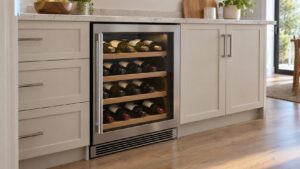
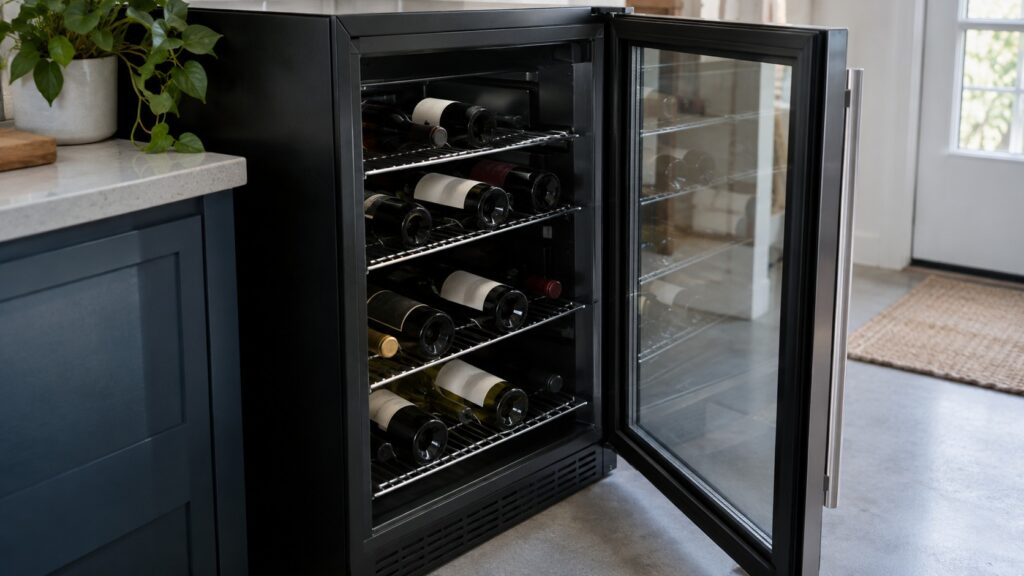
How an Amana wine cooler works is simpler than most people expect: it is a small compressor refrigerator with a single temperature zone. A thermostat senses the cabinet temperature and starts the compressor when it is too warm; the compressor moves refrigerant through coils that carry heat out of the cabinet; and the insulated glass door and walls keep that cold in. The Amana models listed on this site, the AMAW16S2MS, AMAW25S2MS and AMAW35S2CW, hold 16, 25 and 35 bottles. They are Amana-branded units made under license by Galanz, which we service as an independent repair company.
What does the compressor do in an Amana wine cooler?
The compressor is the heart of the cooling system. It squeezes refrigerant vapor, which makes it hot and pressurized. That gas flows through the condenser, a set of coils on the back or sides of the cabinet, where it gives up heat to the room and turns into a liquid. The liquid then passes through a narrow restriction, expands and becomes very cold in the evaporator inside the cabinet. As cabinet air passes over the cold evaporator, it loses heat and the inside cools. The refrigerant then returns to the compressor as a vapor and the cycle repeats.
That is the same principle as a kitchen refrigerator, scaled down. It also explains two common facts: the outside of the cabinet and the area around the back can feel warm because that is where the heat goes, and a wine cooler needs air space around it to work properly.
How does the single-zone thermostat decide when to cool?
Single-zone means the whole cabinet is held at one temperature. A thermostat measures the cabinet air; on these models it is a mechanical dial or an LED-style control with no code readout. When the temperature rises above the set point by a small margin, the thermostat starts the compressor. When the cabinet has cooled to just below the set point, the compressor stops. That cycle of on and off is normal, and it is why you hear the cooler start and stop through the day rather than run constantly. A wine cooler holds a steadier, warmer range than a refrigerator; storage is typically kept around the mid-50s Fahrenheit, with serving temperatures slightly different for reds and whites.
Why does the door and cabinet design matter for wine?
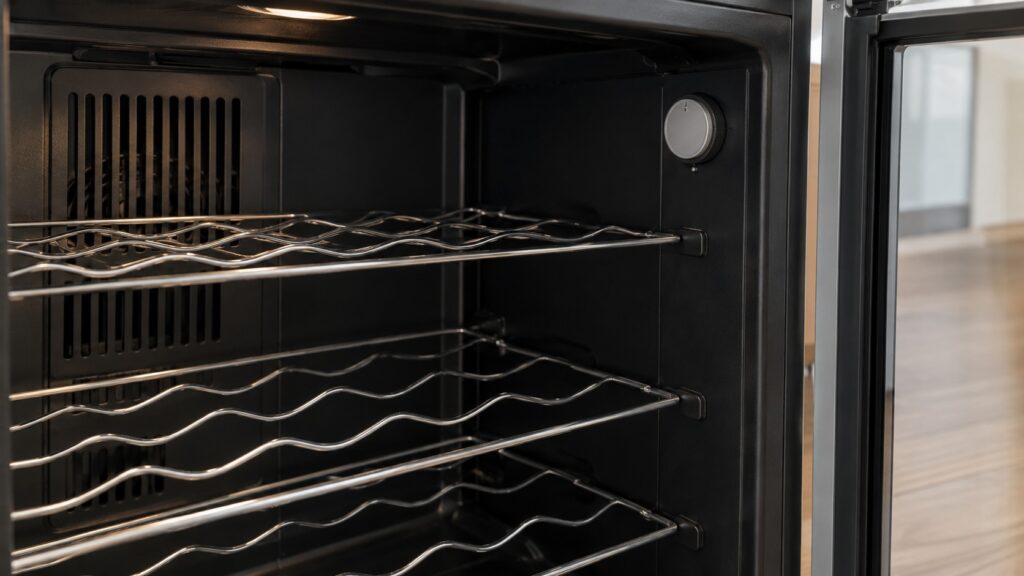
Wine suffers from three things: heat, strong light and vibration. The insulated cabinet keeps temperature steady. The glass door shows off your bottles, and a modest interior LED light lets you see them without a hot bulb; leave it off when not needed, because light adds a little heat and long exposure is bad for wine. Wire shelving holds bottles on their sides so corks stay moist, and lets cold air move between them. Because a compressor is a moving part, wine coolers can send a little vibration into the cabinet, so avoid placing the cooler on a shaky surface.
When you install one, a level, ventilated spot makes a difference; our Amana wine cooler installation guide covers placement, and the wine cooler tips guide covers loading and temperature.
How should you set it up so the cycle works well?
Give the cooler room to breathe. Leave a few inches of space at the back and sides, or follow the clearance in the manual, so the condenser can release heat. Keep it out of direct sunlight and away from an oven, a dishwasher or a heating vent, because a warmer room makes the compressor run longer and cool less. Place it on a firm, level floor and let it stand upright for several hours before plugging it in if it was moved on its side, so the oil in the compressor settles. After you power it up, give it several hours to reach the set temperature before loading bottles. Wipe the condenser area with a soft brush now and then; dust there is a quiet cause of poor cooling.
Why does an Amana wine cooler show no error codes?
Because it has no electronic readout. The control is a thermostat, not a computer, so a fault is not displayed as a code. A problem shows up as a symptom: not cooling, too cold, noisy or a light that does not come on. That makes it simple, but it means you have to observe. If the cooler is warmer than it should be, read our Amana wine cooler not cooling guide. If it freezes bottles or runs far too cold, read wine cooler too cold. For noise and light problems, see wine cooler light and noise.
What sounds and behaviors are normal?
A low hum when the compressor is running, a soft click when it starts or stops, and a gentle gurgle as refrigerant moves are all normal. The cooler cycling on and off is normal. A warm back or side panel is normal. Loud rattling, a buzzing that does not stop, or a compressor that runs constantly without cooling are not. Condensation on the glass in a humid room is common; wipe it and check the door seal. A cooler that is overpacked can block air circulation and cool unevenly, so leave space between bottles and the back wall.
We are an independent repair company, not the manufacturer, and we will say so if an older small cooler is not worth fixing; the decision is covered in our Amana wine cooler repair or replace guide. If yours has stopped cooling, our Amana wine cooler repair service can diagnose it, and you can schedule a visit online.
If you plan to keep wine for years rather than weeks, also place the cooler away from washers and other vibrating appliances, and check the thermometer reading now and then instead of trusting the dial alone.