An ice maker is a module, not an appliance, and that single fact answers most of the amana ice maker repair or replace question before any price is discussed. It bolts into a refrigerator that may have a decade left, it is served by parts that are individually inexpensive, and in the rare case where the whole assembly has to go, it goes without touching the sealed system that makes the refrigerator valuable.
Why the module framing matters
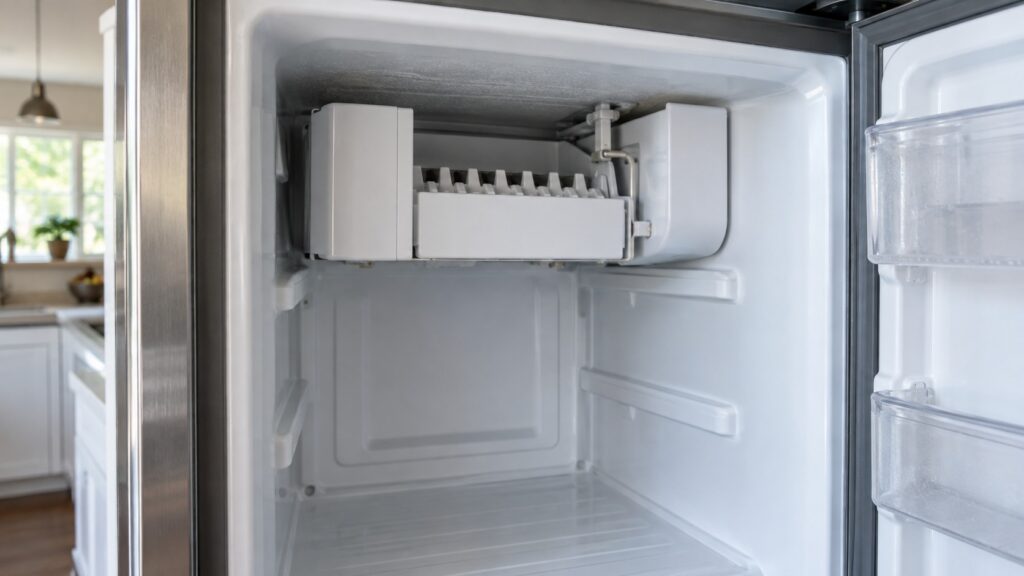
People price this question as though the refrigerator were at stake, and it almost never is. The ice maker is a self-contained head that mounts inside the freezer and connects with a wiring plug and a water line. Replacing the whole head is a routine job, and it leaves the compressor, the evaporator, the doors and the cabinet entirely untouched.
So the sum is not “repair or replace the refrigerator”. It is “repair a part of the head or replace the head”, and both are ordinary. The refrigerator only enters the conversation when it has other problems of its own.
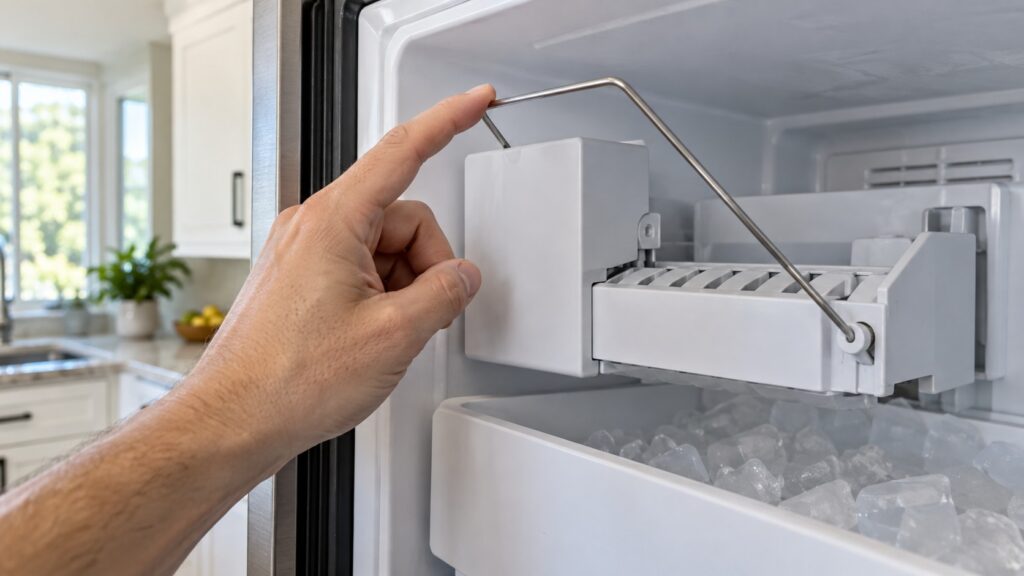
First, establish it is the ice maker
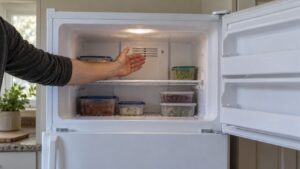
A large share of the ice makers we are asked to price are working correctly and being starved. The supply side has four failure points that all present as an ice maker problem: a supply valve someone closed, a filter so blocked that flow has collapsed, a fill tube frozen solid, and a fill valve that opens partially.
- No water in the mold at all — supply side, not the head.
- Small or hollow cubes — partial flow. Filter or valve.
- Mold fills but never ejects — the head: heater, motor or thermostat.
- Ice forms slowly — freezer temperature or airflow, not the head.
Our page on an ice maker that is not working walks through the split, and the maintenance guide covers what prevents most of it.
The parts, and roughly what they cost you
None of the individual components is expensive relative to a refrigerator. A fill valve is a small solenoid. A mold heater is a resistive element. A thermostat is a switch. The eject motor is a low-power gearmotor. The bail arm that senses a full bin is a piece of wire on a pivot, and it is one of the most common causes of “no ice” — knocked out of position by a bag of frozen peas and holding the machine switched off.
Because the parts are cheap and the labor is a single visit, repair wins easily on anything short of a dead module. Even a dead module is a part rather than an appliance decision on a refrigerator with years left.
Where it stops being worth doing
Three situations change the answer. The first is a refrigerator with other faults — a failing compressor, a corroded liner, a door that no longer seals. Money spent on ice while the appliance is failing around it is money lost, and our refrigerator repair or replace guide is the right place to start instead.
The second is an obsolete module with no available replacement, which happens on older units and is the one genuinely uneconomic case. The third is a refrigerator so old that any spend is hard to justify — though note that “old” for a refrigerator is longer than people assume, and an appliance that still holds temperature reliably is not old in the way that matters.
The option people forget
You can simply switch it off. An ice maker that has failed on an otherwise excellent refrigerator does not have to be fixed at all — raise the bail arm, close the supply valve, and use trays. That is not a defeat; for a household that rarely uses ice it is the rational choice, and it costs nothing.
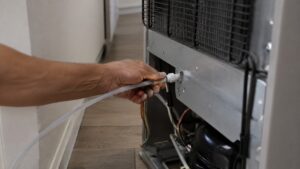
What matters if you take that route is turning the water off properly at the valve rather than leaving a live supply to a disconnected machine. A supply line left pressurized to a module that is no longer maintained is how a slow leak starts behind an appliance nobody moves.
Age, and the signal it is not
People price this decision by the age of the refrigerator, and age is a weak signal for an ice maker specifically. The module works in short bursts a few times a day rather than running continuously, and it lives in a stable, cold, dry environment. What actually ages it is water — mineral deposits from hard water on the fill tube and in the mold, and the corrosion that follows a leak that was never found.
So a twelve-year-old ice maker on soft water may be mechanically young, while a five-year-old one on hard water with a filter that has never been changed may be at the end. When we assess one, the questions are about the water and the history rather than the year it was bought.
What a diagnosis establishes
Four questions decide it, and none can be answered over the phone. Is water reaching the mold? Does the mold heat and eject? Is the freezer holding its temperature? And is the rest of the refrigerator sound? A unit that fails only the second question is a head repair, every time.
The fourth question is the one worth insisting on. It is the difference between a sensible repair and money spent on an appliance that will be replaced within the year.
Getting an honest number
We are an independent repair company, not a factory service arm and not a dealer, so we have nothing to sell you on the replacement side. Where a repair is not worth doing, we say so and explain why. Pricing starts from a diagnostic visit and we confirm the estimate before any work begins.
Amana refrigerator repair covers the ice maker, the water circuit and the refrigeration system, and you can schedule a visit online. If the complaint is overflowing rather than absent ice, our page on that is the right one — it is usually a valve rather than the head.