Smart amana refrigerator organization does more than look tidy — it keeps cold air circulating so every shelf holds its set temperature and your food lasts longer.
It helps to know how the appliance works. An Amana refrigerator is a frost-free, air-circulated system: a single evaporator coil in the freezer is chilled by the sealed system, and a fan pushes that cold air through ducts into the fresh-food section, with a damper metering how much each compartment receives. On a timed schedule the control briefly warms the coil to melt frost so air keeps moving. The display carries only two consumer codes — the PO power-outage alert and the Door Ajar icon — so almost every cooling or ice problem is traced to a real part rather than read off a code.
Store food by temperature zone
The coldest part of an Amana fridge is the back of the lowest shelf, and the warmest is the door. Match each food to the zone that suits it instead of grabbing the nearest empty spot. That single habit prevents most premature spoilage and odd freezing.
- Lowest shelf (coldest): raw meat, poultry, and fish, ideally on a tray to catch drips.
- Middle shelves: leftovers, dairy, and ready-to-eat foods at a steady, even temperature.
- Door shelves (warmest): condiments, juice, and water — not milk or eggs.
- Crisper drawers: produce, sorted by the humidity each type prefers.
Use the crisper humidity sliders
Amana crisper drawers have a humidity control for a reason. High humidity traps moisture for leafy greens that wilt; low humidity vents moisture for fruit that rots when it sweats. Loading both produce types into one drawer on one setting is the most common storage mistake.
- High humidity: lettuce, spinach, herbs, broccoli, and other leafy greens.
- Low humidity: apples, pears, and most whole fruit that gives off ethylene gas.
Don’t block the vents
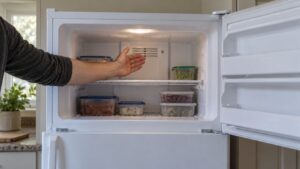
Cold air enters the fresh-food section through vents usually at the back near the top. Packing tall items against them starves the lower shelves of cold air and overworks the compressor. Leave a finger-width gap around every vent and avoid overfilling — air needs room to move for the whole cabinet to stay cold.
Watch the door and the temperature setting
The door is the warmest part of the cabinet because it swings into room air every time you open it, so temperature-sensitive foods like milk and eggs belong on an interior shelf rather than in the door — a habit that matters for food safety, since the fresh-food section should sit at or below 40°F. If you have recently rearranged a packed refrigerator and a shelf now runs warm, give it a few hours before judging it: the compressor needs time to pull a large warm load back down, and the airflow you freed up by clearing the vents does the rest. Resist the urge to crank the control colder to compensate, which usually just freezes the items nearest the vent.
Habits that prevent service calls
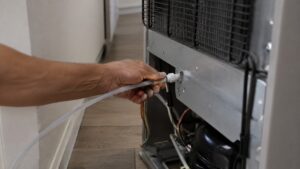
Most problems that send people searching for a repair start small and build up quietly. A few minutes of regular attention prevents the majority of them: keep the appliance clean where residue and lint collect, check the seals and connections a couple of times a year, and act on the first sign of a change in performance rather than waiting for a hard failure. These habits cost nothing, extend the life of the appliance, and keep it running efficiently — and they make any eventual repair smaller, because a problem caught early rarely takes the rest of the system down with it.
When to call a technician
If one zone stays warm no matter how you load it, or the fresh-food side warms while the freezer stays cold, that points to an airflow or defrost problem rather than organization. At that point a technician should check the evaporator fan and defrost circuit.
Quick reference
The short version of this guide:
- Store food by temperature zone.
- Use the crisper humidity sliders.
- Don’t block the vents.
If a problem persists after trying these steps, an experienced Amana technician can diagnose it on site rather than leaving you to replace parts on a guess. Book a visit through our refrigerator repair service, look up a problem on our Amana error-code pages, or browse the full Amana guides library for more troubleshooting and maintenance help across every appliance we service.