An Amana refrigerator ice maker needs three things to make ice: a freezer cold enough to freeze water, clean water flowing through the filter and the inlet valve, and a working module that harvests the cubes and ejects them into the bin. Each cycle, the water inlet valve opens briefly and fills the mold to a set level, the water freezes, and the module releases the cubes. Knowing that sequence turns most ice complaints, from no ice to overflowing, into a question about which stage failed.
How does an Amana refrigerator ice maker work?
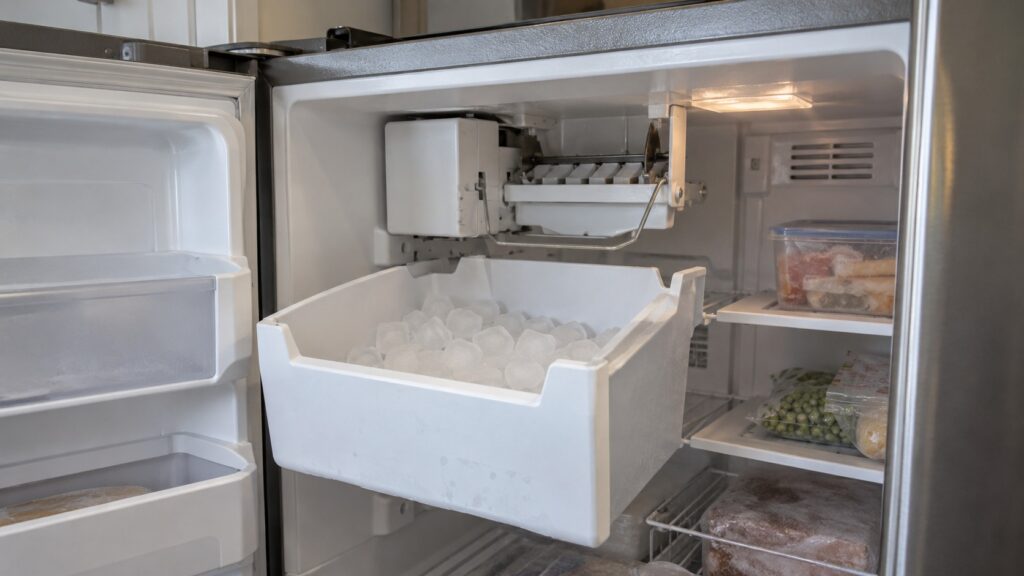
The ice maker sits in the freezer. Water arrives from the home supply line, passes through the EveryDrop water filter and reaches the water inlet valve at the back of the refrigerator. When the module calls for a batch, the valve opens briefly and a fill tube delivers water into the mold. The freezer’s cold turns that water into cubes. Then the module goes through its harvest step and ejects the cubes into the bin below. The cycle repeats until the bin is full or the arm or switch tells the maker to stop.
That is the whole principle, and it explains why ice problems usually come from one of the three requirements: cold, water or the module.
What does the freezer have to do?
Our guide on an Amana ice maker that is not working says the ice maker needs the freezer to hold about 0 degrees F, and that a too-warm freezer simply will not freeze a batch. That is why a freezer that has drifted warm, or one packed so full that air cannot move past the ice maker, slows ice production. Our ice maker maintenance guide adds that a freezer set warmer than it used to be lengthens every harvest cycle, and that keeping the vents clear matters.
It also explains an unexpected thing: a household ice maker makes a batch and then has to refreeze, so filling an empty bin takes the better part of a day, not an hour. That is normal, not a fault.
How does water reach the mold?
Water comes from the supply line, through the EveryDrop water filter and the water inlet valve. If any part of that path is restricted, the mold gets less water. A closed or kinked supply, a clogged filter, a frozen fill tube or a failed inlet valve starves the ice maker, and our not-working guide lists those as the usual causes. Change the filter about every six months, as the maintenance guide advises, and check the supply line for kinks and damp connections once a year. See how to replace the Amana EveryDrop water filter for the steps.
The fill tube delivers the water into the mold. If the fill cup or tube is out of alignment, water can miss the mold, and our overflowing guide lists that among the causes of overfilling.
What happens during harvest?
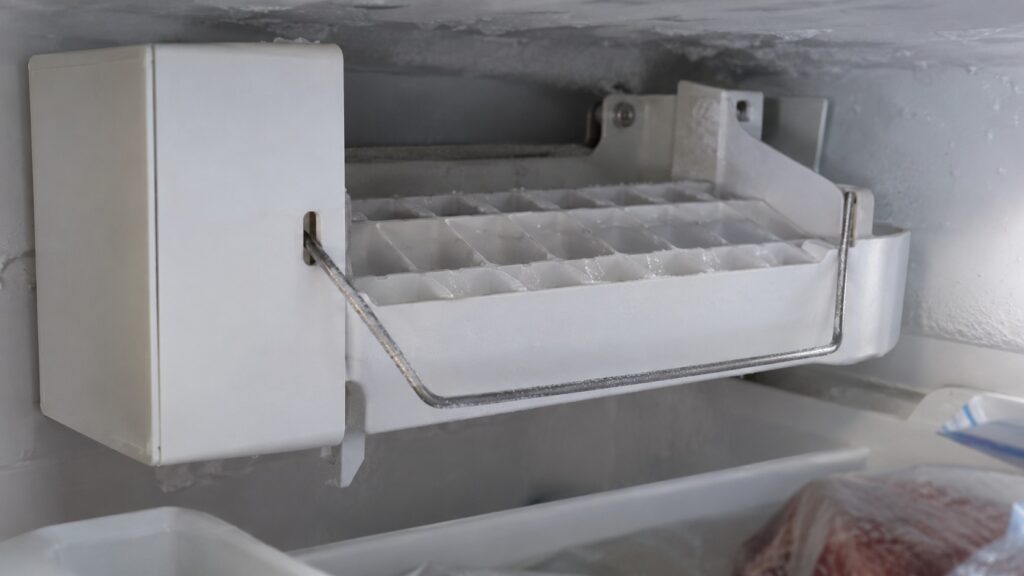
When the cubes are frozen, the module harvests them: it releases the cubes from the mold and ejects them into the bin. Our maintenance guide says that a mold that fills but never ejects points at the harvest mechanism or its heater, and our not-working guide says that water reaching the maker with no cubes forming points to a failed ice-maker module or thermostat. Those are parts for a technician to test, not for an owner to open. Do not force a stuck mechanism, because a mistake can turn a small repair into a bigger one.
One more control belongs here: the wire arm. Our troubleshooting guide says to confirm that the ice maker is switched on and that its wire arm or feeler is not stuck in the up, or off, position. The arm is how the ice maker knows to pause: with the arm up the maker stops, and with the bin full the maker has no room for more. That is why an arm stuck in the wrong position looks like a broken ice maker. Check it gently with your hand, and leave anything that does not move easily to a technician.
Where does the dispenser fit in?
On the side-by-side ASI models, our buying guide describes a Dual Pad external ice and water dispenser. The ice that the dispenser delivers comes from the same bin the ice maker fills, so a bin that is empty, jammed or full of fused cubes affects what the dispenser can give you. If the dispenser has no water, see Amana refrigerator no water from the dispenser. We do not have a description of the dispenser’s internal workings on the site, and we will not guess at them.
What do the symptoms tell you?
- No ice and no water in the mold: the supply is not reaching the machine. Check the filter, the supply valve and the fill tube. See Amana ice maker not working.
- Water in the mold but no cubes, or cubes that never eject: the module, its thermostat or its heater.
- Too much water, oversized or fused cubes: a valve that does not close fully, a misaligned fill tube or an unlevel refrigerator. See Amana ice maker overflowing.
- Small or hollow cubes: a mold that is not filling completely, for example from low pressure or a partly blocked filter.
- Slow ice: a warm freezer or blocked airflow around the maker.
Water on the freezer floor or under the crisper drawers can also come from a clogged defrost drain, which is a separate drain from the ice maker; see Amana refrigerator defrost drain clogged.
What can you safely do, and when should you call?
You can check that the ice maker is on, that the arm is not stuck, that the freezer is cold, that the filter is not overdue and that the supply line is not kinked. Our Amana ice maker maintenance guide lists the calendar. Do not open the module, do not reach into a running mechanism and do not work on the water inlet valve behind the refrigerator. If you see water near an outlet, switch off the breaker at the panel while standing on a dry floor and never pull a plug from a wet outlet. Call a technician if water reaches the mold and no ice forms, if the ice maker overflows or if the problem returns. See Amana refrigerator repair for how a visit works.